
The Japanese Military Administration (Gunsei) and Lt. Col. Yoshinari Tanaka: Shared Responsibility for the Execution of Brigadier General Guy O. Fort, November 1942
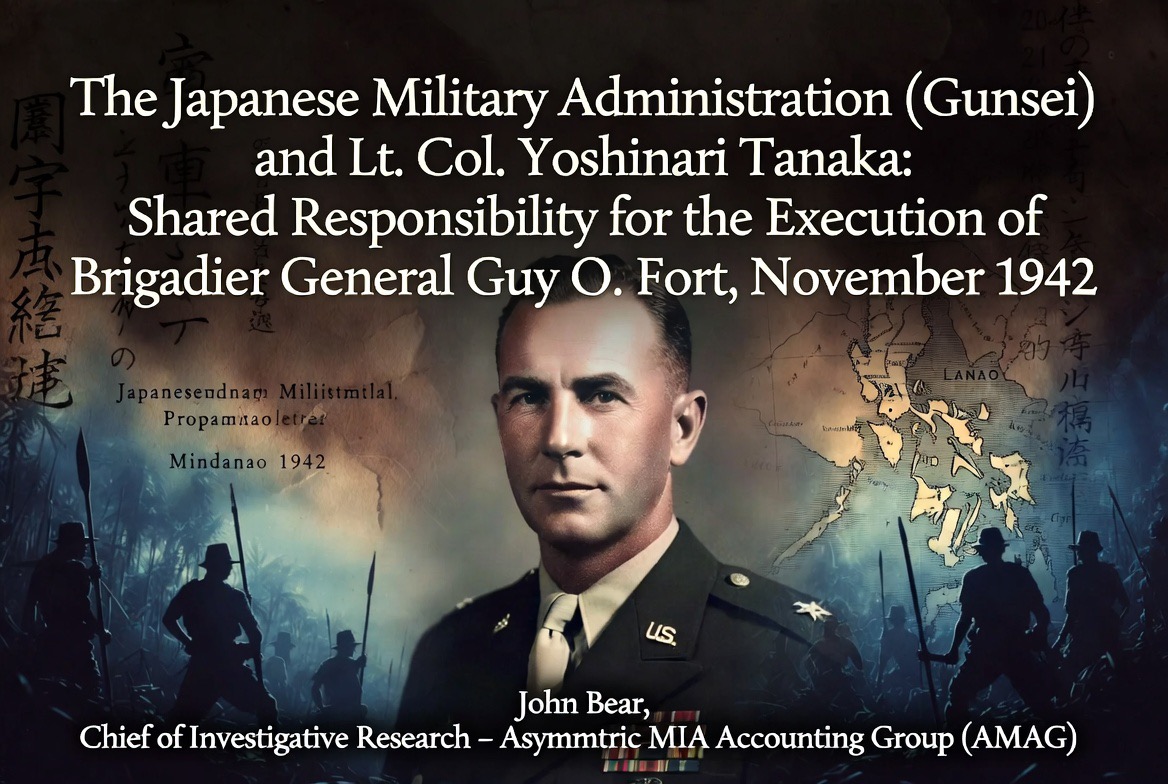
Author: John Bear, Chief of Investigative Research – Asymmetric MIA Accounting Group (AMAG)
Date: May 1, 2026
Prepared for: Asymmetric MIA Accounting Group (AMAG) BG Guy O. Fort Case File
Executive Summary
Primary sources from the Yokohama War Crimes Tribunal and declassified U.S. documents (NND 883678) establish that the execution of Brigadier General Guy O. Fort on or about 11 November 1942 was a coordinated act for which Major General Yoshikazu Morimoto, Chief of the Mindanao Military Government (Gunsei), bears full shared responsibility alongside local garrison commander Lt. Col. Yoshinari Tanaka. Morimoto explicitly directed the strategic use of Fort as a propaganda asset to pacify Maranao resistance in Lanao. Despite clear evidence in tribunal testimony, Morimoto’s central role was never publicly prosecuted or adequately stated in postwar accounts—largely because he died in February 1944, before the major trials. This paper reconstructs the decision-making chain and argues that historical justice requires full recognition of Gunsei-level culpability.
Abstract
Primary sources from the Yokohama War Crimes Tribunal and declassified U.S. documents (NND 883678) establish that the execution of Brigadier General Guy O. Fort on or about 11 November 1942 was a coordinated act for which Major General Yoshikazu Morimoto, Chief of the Mindanao Military Government (Gunsei), bears full shared responsibility alongside local garrison commander Lt. Col. Yoshinari Tanaka. Morimoto explicitly directed the strategic use of Fort as a propaganda asset to pacify Maranao resistance in Lanao. Despite clear evidence in tribunal testimony, Morimoto’s central role was never publicly prosecuted or adequately stated in postwar accounts—largely because he died in February 1944, before the major trials. This paper reconstructs the decision-making chain and argues that historical justice requires full recognition of Gunsei-level culpability.
Introduction
The execution of Brig. Gen. Guy O. Fort was not an isolated atrocity by a local commander. It was the direct outcome of a high-level Japanese Military Administration (Gunsei) policy in Mindanao and Sulu. Major General Yoshikazu Morimoto (森本 義一; also rendered as Giichi or Gichi Morimoto in some Allied/WWII-era English documents; 1887–1944) served as Chief of the Mindanao Military Government and, together with local garrison commander Lt. Col. Yoshinari Tanaka, bears full shared responsibility. Morimoto set the strategic direction; Tanaka carried out the order. That Morimoto’s role has remained largely unstated in public historical narratives is a significant omission that this analysis seeks to correct.
Maranao Resistance in Lanao: The Fighting Bolo Battalion and Unyielding Defiance
The Maranao people of Lanao had a long tradition of resisting foreign domination, from Spanish colonial campaigns through American rule. This deep-rooted spirit of autonomy and martial prowess proved decisive during the Japanese occupation. In early 1942, Brig. Gen. Guy O. Fort, commander of the 81st Division and the Lanao Sector, recognized this potential and actively organized thousands of Maranao fighters into the Lanao Bolo Battalion (also known as the Fighting Bolo Battalion). Sector commanders included prominent Maranao datus such as Datu Busran Kalaw, Manalao Mindalano, Domocao Alonto, and Muhammad Ali Dimaporo.
These units, armed primarily with traditional bolos, kampilans, and limited firearms, were motivated by loyalty to Fort and a fierce determination to defend their homeland. When Japanese forces advanced into Lanao after the May 1942 surrenders, the Maranao resistance did not collapse. Instead, remnants of the Bolo Battalion transitioned into highly effective guerrilla forces that controlled much of the interior around Lake Lanao.
The Maranao response was immediate and uncompromising. On 30 June 1942, Aminita Kalaw, Chief of Staff of Datu Busran Kalaw’s Fighting Bolo Battalion, delivered a blistering Jawi-script reply to early Japanese propaganda appeals from Major Hiramatsu. In traditional formal language, it declared:
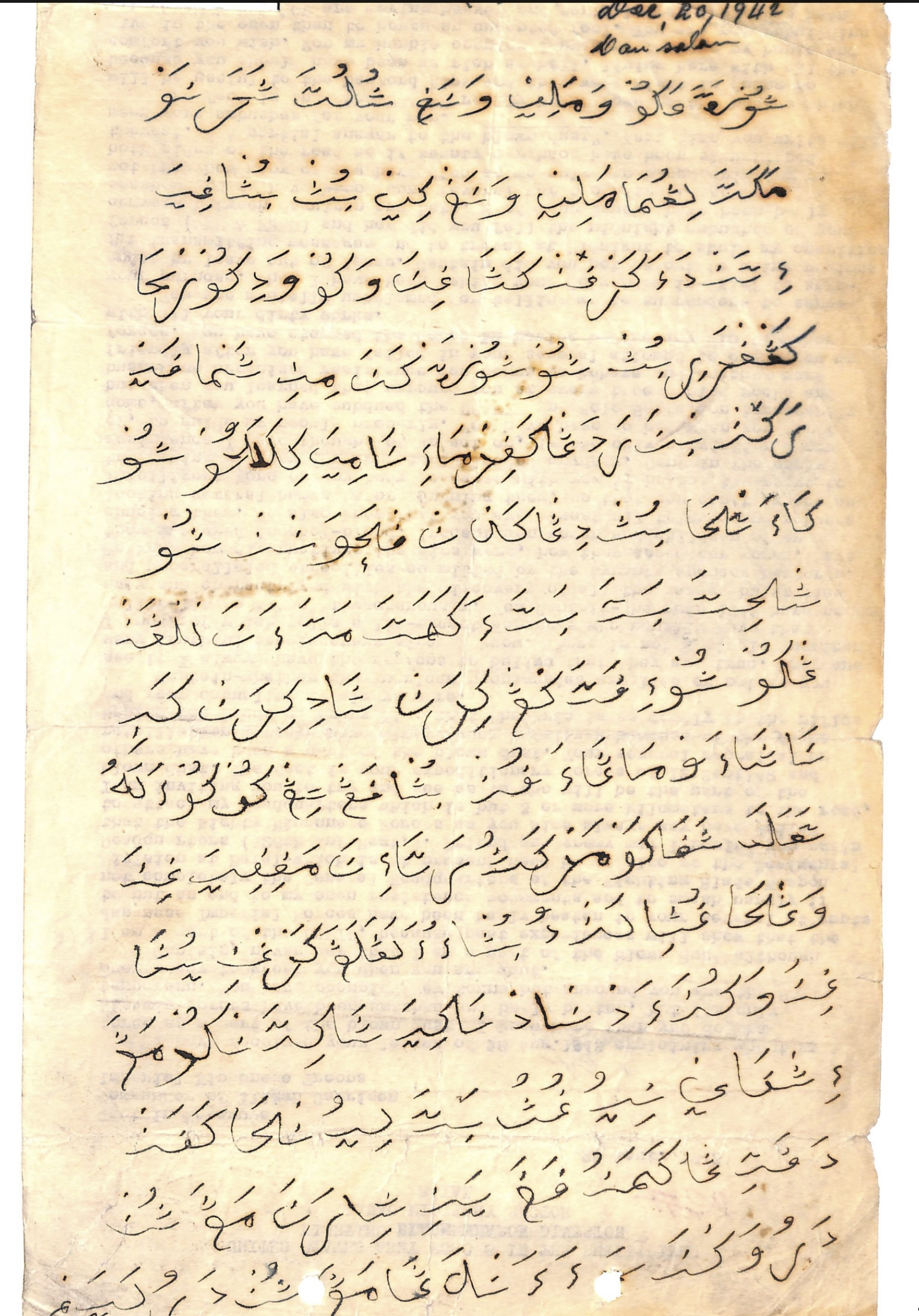 “We, the Maranao people of Lanao, reject your proposal in its entirety… We bear witness before God that we will never surrender and never submit… We still possess our bolos and our old, rusty guns—and we are fully prepared to fight to the death.”
The full text of Aminita Kalaw’s reply further underscores the depth of this defiance (declassified NND 883678):
“We do not want you nor expect you to perform your slavery mission in our province… You Japs with the guidance of William Tate and his men have killed so many people in cool blood and have burned several hundred homes… For every letter any one of you may sent to us will be answered few days by guns and Crises, so stop writing and try hitting to attack us, so we will have some more war trophies. Stop writing.”
This letter set the tone for sustained resistance. By September 1942, a major Moro uprising erupted in the Lanao area. On 12 September 1942, in the Battle of Tamparan (on the eastern shore of Lake Lanao), Maranao villagers—armed mostly with blades—launched a spontaneous surprise attack on a Japanese infantry company. The Maranao forces nearly annihilated the unit in what became one of the gravest defeats inflicted on the Imperial Japanese Army by irregular forces anywhere in the Philippines. Japanese casualty figures from this single engagement reached into the hundreds, with some accounts citing 178 killed in under two hours.
Throughout 1942–1944, Maranao guerrilla units under leaders like Datu Busran Kalaw conducted near-weekly ambushes, raids, and harassment operations against Japanese forces. These actions made large portions of Lanao ungovernable, inflicted unsustainable losses, and forced the Japanese to abandon further large-scale military operations. The Maranao resistance was decentralized, culturally rooted, and ideologically driven by a refusal to submit to any foreign occupier—qualities that rendered conventional Japanese pacification tactics ineffective.
The Gunsei Decision: Major General Yoshikazu Morimoto’s Direct Role
Faced with this unrelenting Maranao resistance, the Japanese Military Administration shifted strategy. In September 1942, while in Dansalan during the uprising, Nobuhiko Jimbo heard Major General Yoshikazu Morimoto confer with other officers:
“MORIMOTO said it would be easier and faster to bring the MOROS under control if we had FORT back.”
Morimoto explicitly advocated retrieving Fort for an intensive propaganda campaign. This decision originated at the highest regional Gunsei level.
Local Execution: Lt. Col. Yoshinari Tanaka
Lt. Col. Yoshinari Tanaka commanded the Dansalan garrison and Camp Keithley POW facility. He personally ordered Fort’s execution by firing squad on or about 11 November 1942 after Fort refused to issue orders for the Moro guerrillas to surrender. Tanaka was convicted in the Yokohama Tribunal and hanged at Sugamo Prison in 1949.
Shared Responsibility: Gunsei Policy + Local Implementation
The evidence shows full shared responsibility:
• Morimoto (Gunsei) formulated the policy: retrieve Fort and use him as a propaganda tool to break Moro resistance.
• Tanaka executed the order on the ground when Fort’s propaganda value could no longer be realized.
This was a coordinated operation between the regional military administration (Gunsei) and the local garrison command.
Failed Japanese Propaganda Campaigns: Tanaka and Koga Outreach
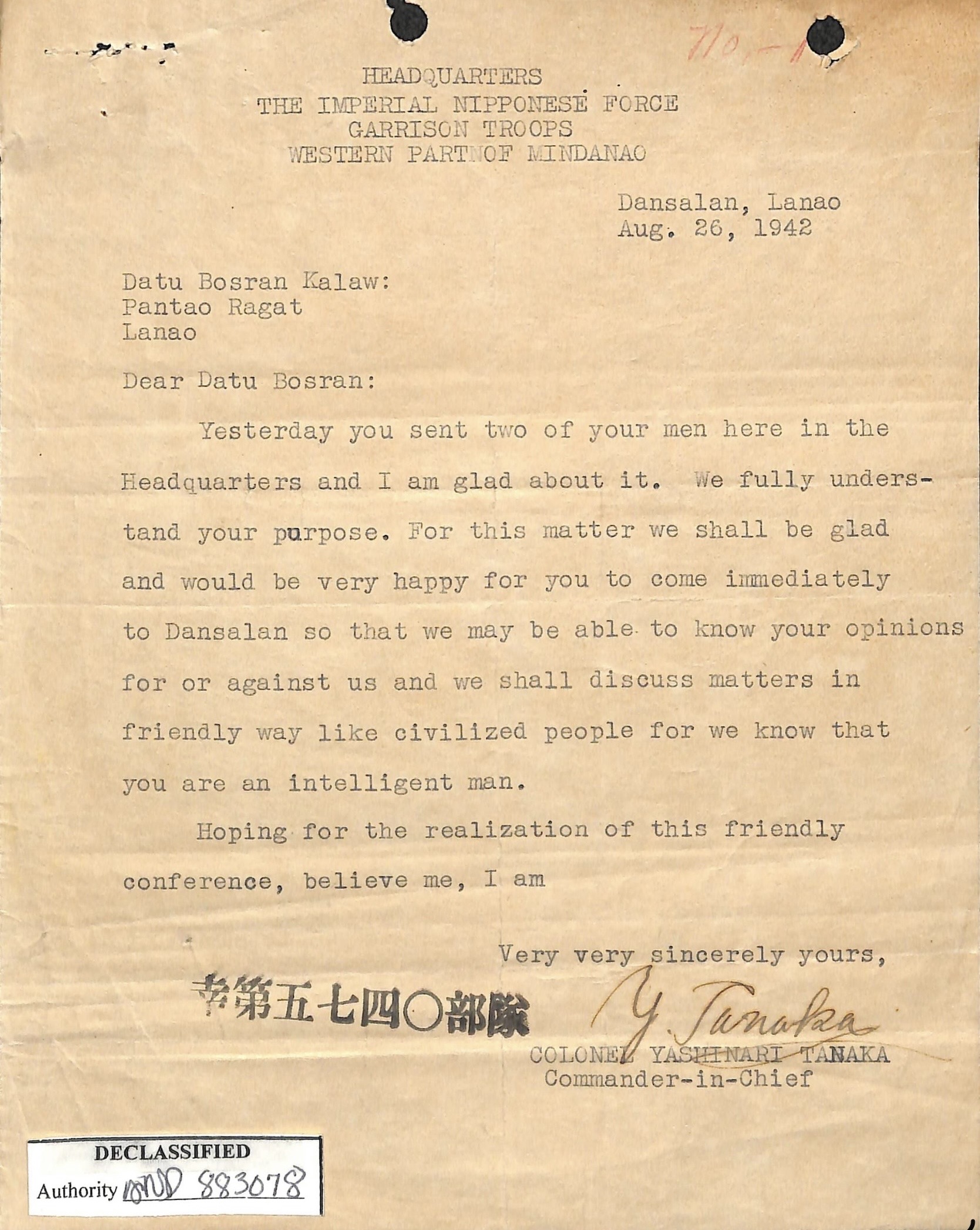 Even as Morimoto pushed to retrieve Fort, local commanders continued direct propaganda efforts that repeatedly failed. On 26 August 1942, Col. Yoshinari Tanaka sent a personal letter to Datu Busran Kalaw attempting a “friendly” conference:
“Dear Datu Bosran: Yesterday you sent two of your men here… we shall be glad and would be very happy for you to come immediately to Dansalan so that we may be able to know your opinions for or against us and we shall discuss matters in friendly way like civilized people…”
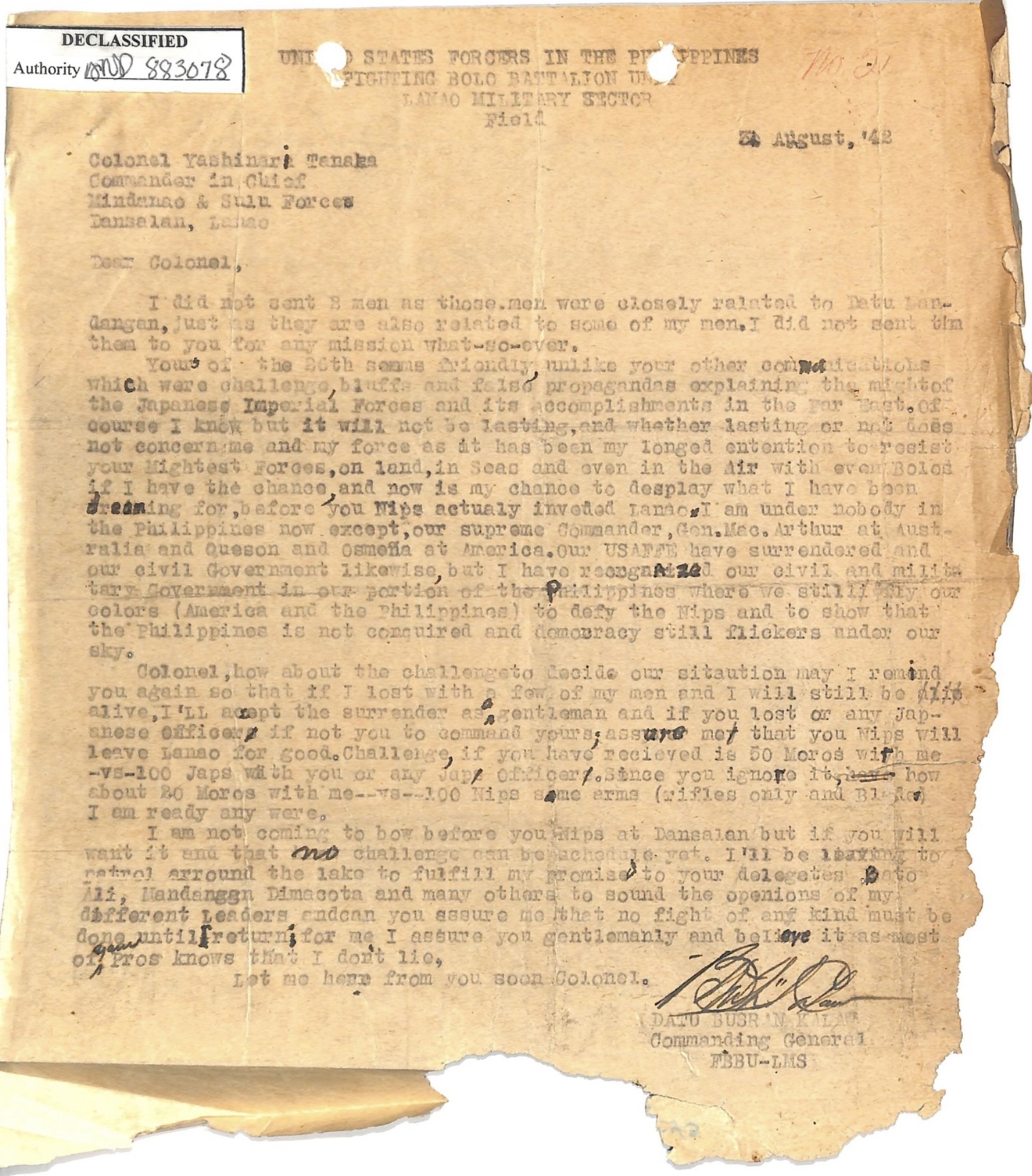
Datu Busran Kalaw’s reply on 28 August 1942 was unequivocal and defiant (NND 883678):
“Colonel, how about the challenge to decide our situation… I am ready any where. I am not coming to bow before you Nips at Dansalan… I have reorganized our civil and military governments… to defy the Nips and to show that the Philippines is not conquered…”
 The persistence of these efforts is further demonstrated by the August 1943 Tokubetsu Kōsaku-tai letter and, most tellingly, by a letter dated 19 November 1942—eight days after Fort’s execution—from Seiji Koga (Director General of the Japanese Military Administration for Mindanao and Sulu and representative of Gen. Morimoto). Koga deliberately perpetuated the fiction that Fort was still alive while invoking the very title phrase of the propaganda campaign:
“We are here to save you from false propaganda.”
This letter reveals both the deception and the continuation of the Gunsei-directed psychological operation even after Fort’s death.
Why Morimoto’s Role Was Not Publicly Stated
Major General Yoshikazu Morimoto died on 12 February 1944 at the age of 56 while still attached to the 14th Army in the Philippines. Japanese military records describe his death as an accident while on official duty (junshoku). Because he predeceased the major proceedings of the Yokohama War Crimes Tribunal, he was never indicted, tried, or publicly held accountable for his actions.
Although Nobuhiko Jimbo’s testimony at Lt. Col. Tanaka’s trial explicitly identified Morimoto as the senior Gunsei officer who directed the effort to retrieve Brig. Gen. Fort for propaganda purposes, this higher-level responsibility received only limited attention in the trial record and virtually none in postwar historical accounts. Morimoto’s extensive career—spanning the Siberian Intervention (1922), command of the Tianjin Garrison Infantry Unit in China (1932–1935), multiple regimental and instructional posts, and his recall to active duty on July 3, 1942, as Army Civil Government Director (Rikugun Shisei Chōkan) for the 14th Army—made him a senior and trusted figure in the military administration apparatus.
His death, combined with the tribunals’ focus on those physically responsible for the execution, allowed the narrative to remain narrowly centered on Lt. Col. Yoshinari Tanaka. This omission has left the strategic Gunsei-level policy direction significantly understated in both official records and popular histories. Japanese sources consistently use the reading Yoshikazu, while some contemporaneous English-language reports employed the alternative on’yomi reading Giichi or Gichi. He is buried at Tama Cemetery (Tama Reien) in Tokyo.
Conclusion
Major General Yoshikazu Morimoto and Lt. Col. Yoshinari Tanaka share full responsibility for the execution of Brigadier General Guy O. Fort. Morimoto’s explicit directive to use Fort for propaganda against the Maranao people of Lanao was the strategic foundation of the crime. That his role was not more forcefully and publicly stated in postwar justice proceedings and subsequent histories represents an incomplete accounting. Full recognition of Gunsei responsibility is essential—not only for historical accuracy but also to honor the Maranao resistance and support ongoing efforts to locate Fort’s remains.
These primary sources (Jimbo testimony, NND 883678 correspondence, and the propaganda letters themselves) now provide a clear evidentiary basis for correcting the record. (See also AMAG Research Paper, “We Are Here to Save You from False Propaganda,” April 23, 2026.)
Footnotes
- James Kelly Morningstar, War and Resistance: The Philippines, 1942–1944 (Ph.D. diss., University of Maryland, 2018), 182.
- “The Battle of Tamparan,” August 26, 2025, https://www.metrocagayandemisamis.com/2025/08/26/the-battle-of-tamparan/.
- Declassified U.S. documents, Authority NND 883678 (Aminita Kalaw reply to Major Hiramatsu, 30 June 1942), National Archives and Records Administration.
- Positively Filipino, “The Battle of Tamparan and the Forgotten Moro Heroes of World War II,” May 4, 2022, https://www.positivelyfilipino.com/magazine/the-battle-of-tamparan-and-the-forgotten-moro-heroes-of-world-war-ii
- Ibid.; see also declassified NND 883678 file and AMAG podcast episode “We Are Here to Save You: Japanese Propaganda in the Execution of General Fort,” https://www.storiesofsacrifice.org/we-are-here-to-save-you-japanese-propaganda-in-the-execution-of-general-fort/ Full AMAG Research Paper: We Are Here to Save You from False Propaganda”: Japanese Psychological Operations, Moro Resistance, Tanaka’s Loss of Control in Lanao, and the Execution of Brigadier General Guy O. Fort https://www.storiesofsacrifice.org/blog/we-are-here-to-save-you-execution-of-brigadier-general-guy-o-fort/
- Yokohama War Crimes Tribunal, Testimony of Nobuhiko Jimbo, Trial of Yoshinari Tanaka, Archive.org transcript, https://archive.org/stream/YokohamaWarCrimesTrials/ICWC21045YoshinariTanaka01_02_djvu.txt
- Yokohama War Crimes Tribunal records, conviction and sentencing of Yoshinari Tanaka (executed 9 April 1949 at Sugamo Prison).
- NND 883678, Tokubetsu Kōsaku-tai letter of 28 August 1943.
- Japanese Army personnel records (JACAR), Tama Reien cemetery records, generals.dk database, and contemporaneous Allied reporting confirm Morimoto’s career and death on 12 February 1944.
Additional References
Morimoto Yoshikazu biographical data compiled from Japanese military records (JACAR), Tama Reien cemetery records, generals.dk database, and the 2013 publication Letters from a Lieutenant General in the Siberian Expedition: The Mystery and Truth of the “Withdrawal”.
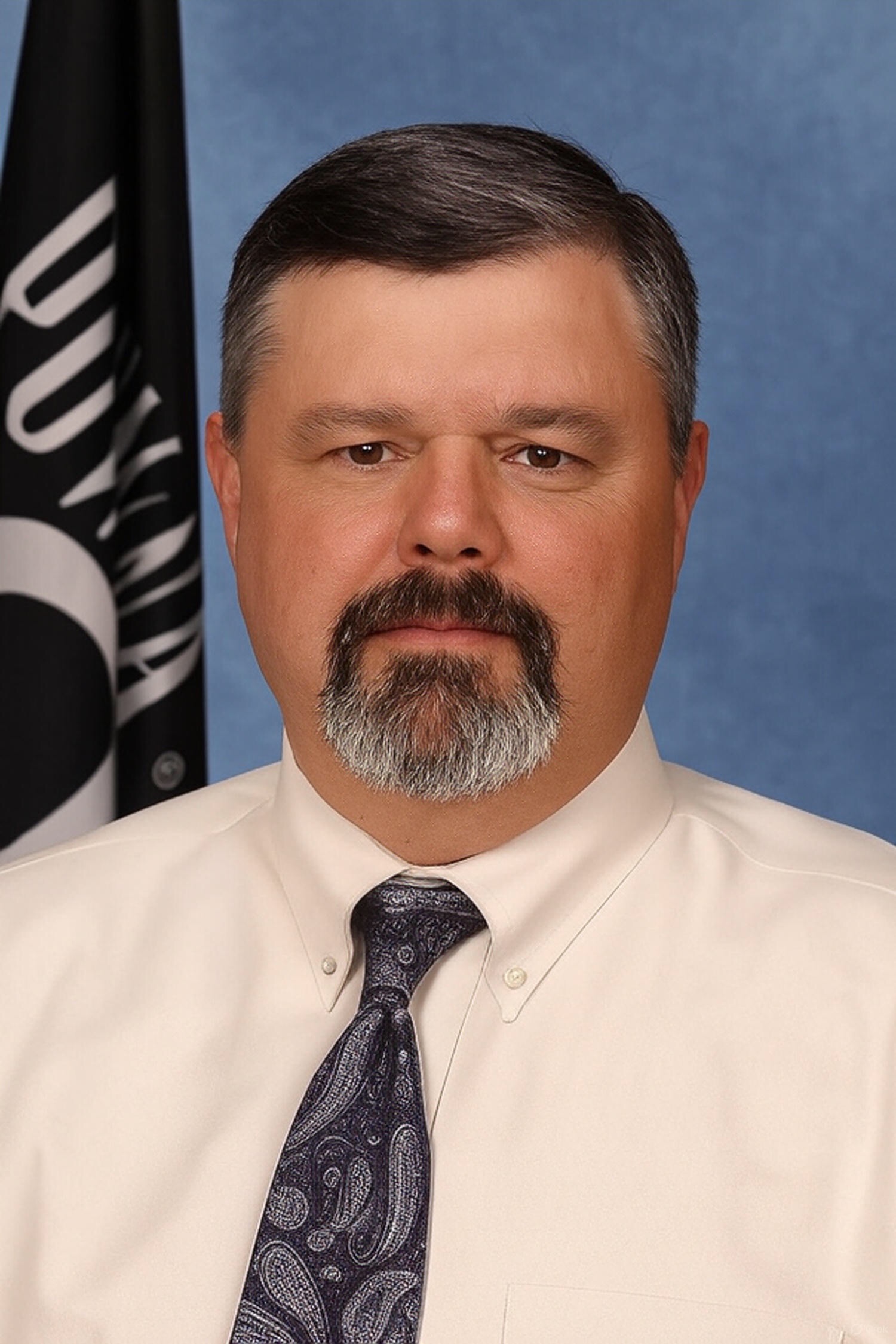
Investigative Researcher & Host of Stories of Sacrifice Podcast
John Bear is an accomplished investigator and forensic genealogist with over 20 years of experience specializing in World War II, Korea, and Vietnam War POW/MIA cases. He has honed forensic-level skills in open-source intelligence (OSINT) and archival research, bolstered by coursework in Advanced Research Methods and Databases for Historians. Inspired by the loss of his uncle, a WWII POW/MIA identified posthumously in the Philippines, John volunteers directly with families of the missing to provide answers and closure. As a key member of the Asymmetric MIA Accounting Group (AMAG), he works directly with MIA families to support projects alongside Military Service Casualty Officers, DPAA Historians, and military intelligence experts. Through his contributions to the Cabanatuan POW Camp, Philippine Hellship Project, and Bataan Death March, John’s efforts have led to over 350 potential WWII identifications through Family Reference Sample (FRS) DNA collection. His investigation into the Vietnam War’s Baron 52 incident uncovered compelling OSINT-based evidence suggesting crew survival, and his work on WWII unrecovered MIAs on Mindanao has generated critical leads. Through his podcast, Stories of Sacrifice: American POW/MIAs, John amplifies families’ stories, ensuring the legacies of the missing are honored.
Baron 52 Docu series Podcast Link: https://www.storiesofsacrifice.org/category/baron-52/
Baron 52: New Vietnamese Sources and the Case for Technical Review


