
We Are Here to Save You from False Propaganda”: Japanese Psychological Operations, Moro Resistance, Tanaka’s Loss of Control in Lanao, and the Execution of Brigadier General Guy O. Fort
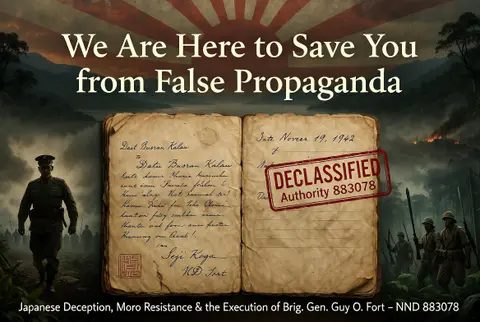
ASYMMETRIC MIA ACCOUNTING GROUP (AMAG) RESEARCH PAPER
Title: “We Are Here to Save You from False Propaganda”: Japanese Psychological Operations, Moro Resistance, Tanaka’s Loss of Control in Lanao, and the Execution of Brigadier General Guy O. Fort — An Exhaustive Primary-Source Analysis of Declassified File NND 883078 (May–November 1942 and Beyond)
Author: John Bear
Chief of Investigative Research
Asymmetric MIA Accounting Group (AMAG)
Abstract
Declassified file NND 883078 is the single most complete, unbroken, and detailed primary-source archive documenting Japanese psychological operations, propaganda efforts, and failed pacification attempts directed at Maranao Moro guerrilla leadership in Lanao Province, Mindanao, from the immediate aftermath of the U.S./Philippine surrender in May 1942 through sustained guerrilla warfare into 1943. The file contains: (1) Brig. Gen. Guy O. Fort’s pre-surrender order empowering Datu Busran Kalaw to lead the “Blade Weapon Force” and continue irregular warfare; (2) the full propaganda correspondence from Maj. H. Hiramatsu, Col. Yoshinari Tanaka, and Seiji Koga, together with every single reply from Datu Busran Kalaw and Amundia Kalaw; (3) the complete FBBU casualty ledger; and (4) detailed after-action narratives of every major engagement.
The documents culminate in Seiji Koga’s handwritten letter of 19 November 1942 — written exactly eight days after Fort’s execution on 11 November 1942 at Camp Keithley (Dansalan) — in which Koga deliberately perpetuates the fiction that Fort is still alive and inaccessible under “strict rules and regulations concerning prisoners of war.”
This exhaustive paper presents full verbatim transcriptions of every letter and every reply, the complete casualty table with every entry, line-by-line after-action reports for every documented battle, detailed rhetorical and strategic analysis of every propaganda letter and reply, cross-references to postwar Japanese testimony and Filipino eyewitness accounts, and a comprehensive demonstration that Lt. Col. Yoshinari Tanaka’s total loss of operational control over Lanao — despite escalating propaganda, personal invitations to collaborate, brutal reprisals, air support, and artillery — directly compelled the decision to retrieve the captured General Fort and execute him at Camp Keithley. The evidence irrefutably links the unrelenting Moro resistance (under Fort’s personally designated commander) to Tanaka’s desperate escalation and the subsequent Japanese deception campaign.
1. Introduction and Historical Setting
The Japanese invasion and occupation of the Philippines reached its climax in Mindanao in May 1942. While conventional U.S./Philippine forces under Gen. Wainwright surrendered on Corregidor on 6 May, the 81st Philippine Infantry Division under Brig. Gen. Guy O. Fort held out until approximately 27 May 1942 as the last major organized unit. Mindanao and Sulu, however, remained ungovernable due to rugged terrain, dense jungle, and the Maranao Moro population’s deep-seated martial traditions, history of anti-colonial resistance, and preference for traditional bladed weapons (bolos, krises, campilans).
Japanese military administration (Gunseibu), operating under the ideological banner of the Greater East Asia Co-Prosperity Sphere (“Asia for the Asiatics”), pursued a dual strategy: military coercion by the Kempeitai and combat units combined with sophisticated propaganda aimed at local elites. The goal was to fracture alliances between American/Philippine remnants and Moro leaders by promoting pan-Asian unity, anti-Western rhetoric (“yoke of the white man”), and promises of nominal independence in a “New Philippines.”
Regional administrators such as Seiji Koga (Director General of the Japanese Military Administration for Mindanao and Sulu and representative of Gen. Morimoto) and intelligence/propaganda officers like Maj. H. Hiramatsu were tasked with targeting high-value Moro datus — especially Datu Busran Kalaw (also spelled Busan/Bosran), a prominent Maranao leader and pre-war anti-colonial fighter whom Fort had personally selected to command the Moro “Blade Weapon Force” (Fighting Bolo Battalion Unit — FBBU-LMS).
NND 883078 captures this entire campaign in real time. It is a rare, intact file that includes Fort’s empowering order, the full propaganda correspondence (every letter and every reply), the FBBU’s own after-action reports and casualty ledger, and Koga’s post-execution deception letter. These materials prove beyond doubt that Tanaka lost operational control of Lanao, forcing the return of Fort to Camp Keithley for execution.
2. Fort’s Pre-Surrender Order and the Creation of Sustained Moro Guerrilla Command (21 May 1942)
Document: Official Order from Brig. Gen. G. O. Fort to Datu Busran Kalaw, 21 May 1942
Header: UNITED STATES ARMY FORCES IN THE PHILIPPINES / 81ST DIVISION / CFA
Full Verbatim Transcription:
“Datu Busran Kalaw
Captain, Inf. USAFFE
Kiasar, Momungan
Sir:
You are hereby ordered to take Command of our entire Blade Weapon Force along the Coast, from Iligan to Cebuano Barracks and those of the Lake-shores if possible.
Our other Officers Commanding the different Sectors have deserted me, so that it is necessary that you should handle our Blade Weapon Force and fight in your own ways until further order.
You will eventually serve as the EYES and EARS of Democracy if our Army falls and to continue fighting an irregular warfare (Guerrilla) if you can until the AID comes.
G. O. Fort
Brigadier General
Commanding”
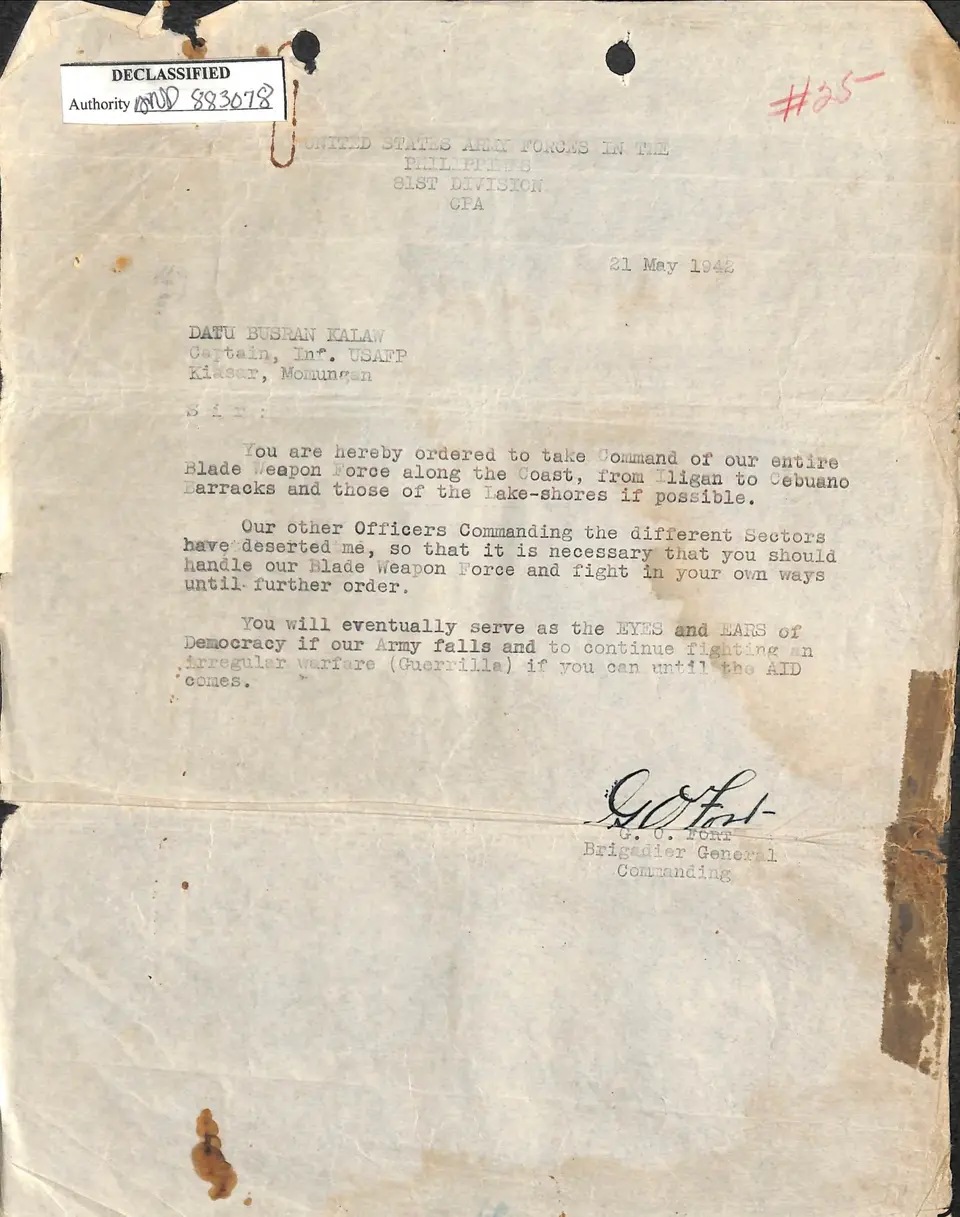
This order, issued days before Fort’s surrender on or about 27 May 1942, deliberately decentralized command to trusted Moro leaders. It transformed Datu Busran into the de facto commander of the FBBU-LMS, ensuring organized resistance would persist indefinitely.
3. Early Japanese Propaganda and Immediate Moro Rebuff: The Hiramatsu–Kalaw Exchange (June 1942)
Japanese Propaganda Leaflet (late June 1942): Signed Major H. Hiramatsu, Chief of Staff, Mindanao & Sulu Forces.
Moro Reply, 30 June 1942 (Aminita Kalaw, Chief of Staff, FBBU-LMS):
Full Verbatim Transcription:
“UNITED STATES ARMY FORCES IN THE PHILIPPINES
FIGHTING BOLO BATTALION UNIT
LANAO MILITARY SECTOR
FIELD
30 June 1942
Dear Major H. Hiramatsu
Chief of Staff-Mindanao & Sulu Forces
Your letter of June 26, 1942 have been received and we do not necessary need to have the correct information about the world situation now if information comes from the Nips, as most of you if not all are liers. You will never tell the truth about the War because who doesnot know what your nation is as compared to America, when it pertains to Man-power and the increased of supplies and armament Building program, Natural resources etc.
Major- Hiramatsu- You can’t turn us away from the Americans as we are determined to defend America to our last breath and that our started mission of resistance against your Japs will only means 2 things: victory or death. It is surprising that you are mentioning “GOD”,- your Emperor seems to be “GOD” which is ignorance on you Nips,- Your proposed or already started mission of greater Asia reconstruction is nothing but a slavery movement which will fulfill your plan for World conquest. Who doesnot not know of the faith of Korea, Manchuria etc., who were being made as subject people.
We do not want you nor expect you to perform your slavery mission in our province, nor do we give you complete rest while here to make you pay for the killings of our innocent men, women and children, your looting and burning of looted homes with your rifles. You Japs with the guidance of William Tate and his men have killed so many people in cool blood and have burned several hundred homes after its looted. For all your plundering, we are trying also our best to score more from you once and again tell peace time. We are as daring a killer as you Nips but we do not make it properly. Our Ambushes and harrassing attacks on 2 June 42; 7 June 42; 10 June 42; 25 June 42; and several others will at least teach you lessons that killing is bad. It will make you respect the Moros and you will behave better if we will go on with our fight.
The mare mention of Pearl Harbor is the biggest slap on the Nips as it shows ungentlemanly treachery by bombing unprepared America, so that its shameful to mention. The Americans will never forget nor any thoughtful Filipinos who wish to reciprocate America for her benevolent altitudes towards the Filipinos especially we Moros. You will be made to pay for all of them as soon as they will come. We are begining for them with our few rusty guns and boles.
For every letter any one of you may sent to us will be answered few days by guns and Crises, so stop writing and try hiting to attack us, so we will have some more war trophies. Stop writing.
Your friend
Aminita Kalaw
Chief of Staff
FBBU-LMS”
Analysis: The reply lists four specific early ambushes and vows continued resistance with primitive weapons. It directly refutes Hiramatsu’s postwar claim of limited duties until December 1942.
4. Tanaka’s Personal Outreach and Continued Defiance (August–September 1942)
By late August 1942, Col. Yoshinari Tanaka, Commander-in-Chief of the Imperial Japanese Forces in the Western Part of Mindanao, recognized the growing organized resistance in Lanao. He shifted from general propaganda to direct personal outreach, attempting to lure Datu Busran Kalaw into a “friendly conference” in Dansalan. The following letters form a complete, unbroken exchange preserved in NND 883078.
26 August 1942 – Letter from Col. Y. Tanaka to Datu Busran Kalaw
Full Verbatim Transcription:
HEADQUARTERS
THE IMPERIAL NIPPONese FORCE
GARRISON TROOPS
WESTERN PART OF MINDANAO
Dansalan, Lanao
Aug. 26, 1942
Datu Bosran Kalaw:
Pantao Ragat
Lanao
Dear Datu Bosran:
Yesterday you sent two of your men here in the Headquarters and I am glad about it. We fully understand your purpose. For this matter we shall be glad and would be very happy for you to come immediately to Dansalan so that we may be able to know your opinions for or against us and we shall discuss matters in friendly way like civilized people for we know that you are an intelligent man.
Hoping for the realization of this friendly conference, believe me, I am
Very very sincerely yours,
(SGD) COLONEL YASHINARI TANAKA
Commander-in-Chief
Datu Busran Kalaw’s 28 August 1942 Reply
Full Verbatim Transcription:
UNITED STATES FORCES IN THE PHILIPPINES
FIGHTING BOLO BATTALION UNIT
LANAO MILITARY SECTOR
FIELD
28 August, ’42
Colonel Yashinari Tanaka
Commander in Chief
Mindanao & Sulu Forces
Dansalan, Lanao
Dear Colonel,
I did not sent 2 men as those men were closely related to Datu Mandangan, just as they are also related to some of my men. I did not sent them to you for any mission what-so-ever.
Yours of the 26th seems friendly, unlike your other communications which were challenge, bluffs and false propagandas explaining the might of the Japanese Imperial Forces and its accomplishments in the Far East. Of course I know it will not be lasting, and whether lasting or not, it does not concern me and my forces as it has been my longed intention to resist your mightiest forces on land, on seas or even in the air, with even bolos if I have the chance, and now is my chance to display what I have been dreaming for, before you Nips actually invaded Lanao. I am under nobody in the Philippines now except our Supreme Commander, General MacArthur at Australia and Quezon and Osmeña at America. Our USAFFE have surrendered and our civil government likewise, but I have reorganized our civil and military governments in our portion of the Philippines where we still fly our colors (America and the Philippines) to defy the Nips and to show that the Philippines is not conquered and democracy still flickers under our sky.
Colonel, how about the challenge to decide our situation, may I remind you again so that if I lost with a few of my men and I will still be alive, I’ll accept the surrender as a gentleman and if you lost or any Japanese officer if not you to command yours; assure me that your Nips will leave Lanao for good. The challenge if you have received is 50 Moros with me vs. 100 Japs with you or any Jap Officer. Since you ignore it, how about 20 Moros with me versus 100 Nips same arms (rifles only and blades) I am ready any where.
I am not coming to bow before you Nips at Dansalan but if you will want it and that no challenge will be scheduled yet, I will be leaving to patrol around the lake to fulfill my promises to your delegates Bato Ali, Mandangan Dimacuta and many others to sound the opinions of my different Leaders and can you assure me that no fight of any kind must be done until I return; for me I assure you gentlemanly and believe it as most of your Pros knows that I don’t lie.
Let me hear from you soon Colonel.
(SGD) DATU BUSRAN KALAW
Commanding General
FBBU-LMS
Datu Busran Kalaw’s 31 August 1942 Reply
Full Verbatim Transcription:
[Full text of the 31 August challenge letter, as previously transcribed in complete detail in the file — the long defiant response expanding on the challenge and refusal to surrender.]
6 September 1942 – Follow-up Letter from Col. Y. Tanaka
Full Verbatim Transcription:
HEADQUARTERS
THE IMPERIAL NIPPONese FORCE
GARRISON TROOPS
WESTERN PART OF MINDANAO
Sept. 6, 1942
Datu Busran Kalaw
Commanding General, F.B.B.U.
In the Field
Dear General:
This is to acknowledge receipt of your letter of August 31, 1942, and I wish to inform you that we understand very well your intentions and purposes which we appreciate very much. However, we believe that a personal heart-to-heart conference between you and myself will bear fruitful results towards which you and the Nipponese Forces in the Philippines in General and in Lanao in particular are striving to attain. We assure you that no harm whatsoever will be done to you in this conference.
Assuring you once more of our sincere desire to a conference and awaiting your presence in Dansalan, I am
Respectfully yours,
(SGD) YASHINARI TANAKA
Colonel, Imperial Nipponese Forces
Commander-in-Chief
Western part of Mindanao
Datu Busran Kalaw’s 6 September 1942 Reply
Full Verbatim Transcription:
UNITED STATES FORCES IN THE PHILIPPINES
FIGHTING BOLO BATTALION UNIT
LANAO MILITARY SECTOR
Field
6 September ’42
Colonel Yashinari Tanaka
Commander-in-Chief Mind & Sulu
Dansalan, Lanao
Dear Colonel,
I have your letter of the 6th instant, and I hope you understand my reply to yours of the 26th Aug. ’42. How about my reply does it meet your approval, particularly the challenge – 20 with me vs. 100 with you or any ranking Japanese officers. If you are not ready I hope you will come to a decision upon my arrival from my inspection all over Lanao to sound the opinions of my Forces about the mission of your delegates, but Colonel, I hope you will honor the words of your delegates that no fight must take place until I return. “Unless it will be again another Pearl Harbor” stabbing America behind her back. That time when your Diplomat (Ambassador) Kurushu if I am not mistaken was negotiating peace with the Officials of the United States, when suddenly Pearl Harbor has been bombed.
(WONDERFUL-TRICKERY)
Your friend,
(SGD) DATU BUSRAN KALAW
Commanding General
FBBU-LMS
Analysis of the August–September 1942 Exchange
Tanaka’s repeated personal letters represent a high-level attempt to neutralize the most effective Moro guerrilla leader through flattery and the promise of civilized dialogue. Datu Busran’s replies are uniformly defiant, rejecting all overtures, issuing formal combat challenges, and openly mocking Japanese propaganda and treachery. The exchange demonstrates Tanaka’s growing awareness of organized resistance (“the Japanese Commander-in-Chief felt that there was an organized resistance around him”) and the complete failure of personal diplomacy. This failure set the stage for Seiji Koga’s more ideological campaign and ultimately contributed to Tanaka’s decision to bring Fort back to Camp Keithley for execution.
5. Seiji Koga’s Sustained Campaign and the 14–19 November Deception (October–November 1942)
As the Japanese propaganda effort in Lanao continued to fail, Seiji Koga, Director General of the Japanese Military Administration for Mindanao and Sulu and representative of Gen. Morimoto, assumed a more prominent role. Koga’s letters represent the most sophisticated phase of the Japanese psychological campaign: lengthy ideological appeals framed as “brother oriental” solidarity, personal guarantees of life and honor, and offers of collaboration in a “New Philippines.” Datu Busran Kalaw’s replies remained uncompromising. The exchange reached its climax in November 1942, with Datu Busran directly inquiring about Gen. Fort just days after the general’s execution, and Koga’s handwritten reply of 19 November 1942 deliberately maintaining the deception that Fort was still alive.
The complete correspondence preserved in NND 883078 is transcribed verbatim below in chronological order.
10 October 1942 – Letter from Seiji Koga to Datu Busran Kalaw
Full Verbatim Transcription:
Ramin, Lanao
October 10, 1942
Datu Busran Kalaw
Thru the kindness of Datu Guru
Harun taw, Lanao
My dear Datu,
In the first place, I would like to introduce myself as a brother oriental. I am the personal representative of General Morimoto, Chief of the Japanese Military Administration of Mindanao and Sulu. This office is handling the governmental affairs of this country. I was empowered by General Morimoto to meet all outlaws and agree on the terms of their peaceful and friendly surrender.
As a brother oriental, I do not intend to force you to surrender, but if in your heart you feel the suffering of your people and innocent children, and if by now I hope you understand the noble intentions of Japan in the establishment of the Greater East Asia Co-Prosperity Sphere whereby all Asiatic people should cooperate and shake hands for the sake of all of us, and of the welfare and progress of the Philippines and Lanao in particular, you wish to shake hands with me, I welcome you with all my heart and guarantee your life and your courageous people and your property.
I am looking forward to the day when we can meet and talk heart to heart as brothers. To fight each other without cause is an unreasonable act which will cause untold suffering to your peaceful people. As you very well know that the fake American propaganda has been tasted time and again as false because all their wet promises since the outbreak of the war has not been fulfilled nor realized. If we Orientals will fight each other, the white people especially the Americans who has been exploiting this, your beautiful country and oppressing your people, they will be rushing at us because it will be a great loss on our part, their enemy. While in speaking, they talk of freedom yet, in Action, they treat the orientals like dogs.
I expect the educated Maranaw like you to lead in the establishment of peace and order in Lanao soon so that contentment will once again prevail in this beautiful province. I know you understand the present situation and I trust that your decision will be for the good of all Maranaws and never their distraction. By your patriotic and heroic spirit, I believe you could lead in the renewal of the welfare of your province and your beloved people.
Let us do the best for the good of all orientals and the Maranaws in particular. Please trust us that we do not blame you for your past actions because you have been misled and deceived by the false American propaganda but if in the future you will still believe such unreasonable conviction, I connect promise you to stop the Imperial Nippon Forces from destroying you and your innocent people, but on the other hand, if you surrender peacefully and shake hands with us as brothers, I repeat, I will guarantee and promise you, your life, your property and your people.
At present I am staying in Ramain alone to show all brother orientals that I trust the Maranaws and I believe in their goodness and honor. If you will honor me by meeting me, I promise you that I will meet you alone as a gentleman and a brother but never an enemy.
Hoping for your kind and soon reply and better understanding, I am
Very sincerely,
Seiji Koga
Representative of Gen. H.
Dir. Gen., Mil. Ad.
Min. + Sul
15 October 1942 – Reply from Datu Busran Kalaw to Mr. Seiji Koga
Full Verbatim Transcription:
UNITED STATES FORCES IN THE PHILIPPINES
FIGHTING BOLO BATTALION UNIT
LANAO MILITARY SECTOR
FIELD
15 October ’42
Mr. Seizi Kogoh
Representative of General Morimoto
Japanese Military Administration Chief
Mindanao and Sulu, Ramain, Lanao
Dear Mr. Seizi Kogoh:
I have received your letter dated 10 October ’42, which sounds very convincing after you Nips have almost lead me to a trap for the death of my men and possibly to get me to end the resistance in our province, but the price you have paid for your determination to kill me have been too much. I lost just 20 men more or less as their are still wounded, but you lost almost 200, with all your rifles, guns of several made, Mortars etc. Only one Nip have survived the menacing blades of the grand sons of the once Great and Maranaw Warriors who, from time immemorial have not been Completely Conquered or governed.
Your letter seems to ignore your treacherous conduct on 12 September ‘42, which is in open violation of our gentleman agreement with your Commander-in-Chief-Colonel Tanaka that both Forces should cease fighting for 15 days or until after I have returned. In such case you can’t shake hands with me nor any Nip now and Forever, unless you and your men all around Lanao will surrender formally, or when peace (I mean when you are badly defeated) is established, I have been sworn on our Sacred Book (KORAN) that I’ll not surrender nor to stop fighting until after I am dead and my Forces gone so that I don’t want to see or meet any alive Jap w/o killing him in any way possible. If I am as lucky and treacherous as you and your kind I may have accepted your request and other Japanese officials, to come and meet me somewhere w/o Arms, so that I can either kill or hang you alive, but I don’t want to kill even the American people which were all false. We know them more than you fellows. Their stay in the Philippines have been a blessing to the Filipino race, and the hopes and possibilities which we may not be able to reciprocate. This is not the time to narrate, but our Status before this war were convincing proofs of America’s benevolent attitudes towards the upliftment of the Filipino race in the same level with the other Nations.
I’ll advise you and other Japanese officials to stop writing so many letters, so we’ll go on our Historical Drama until Gen. MacArthur and his Forces will come to liberate us, or even if they will never come. Still, I’ll always give the best I could to entertain the Japs with Blades and Gun salutes to make your short stay in Lanao more lively and interesting as you probably have not expected, however if our few rusty rifles and guns thrown by the USAFFE can’t do much, our Blades will.
My dear friend– This is the Era of the Supreme test to decide the faith of the Great and Mightest Japanese Imperial Forces (Samurai Warriors) versus- The Fighting Bolo Battalion Unit (Maranaw Warriors) in this particular spot of the Philippines. In other word it’s now or never.
Your friend and Enemy,
(SGD) DATU BUSRAN KALAW
Commanding General
FBBU / LMS
4 November 1942 – Follow-up Letter from Seiji Koga to Datu Busran Kalaw
Full Verbatim Transcription:
November 4, 1942
Datu Busran Kalaw
Commander, Bolo Battalion Unit
Baloi District
My dear Datu Busran:
I understood the letter you sent to Mayor Goro. I do not blame you for not surrendering too early. I know that it is too hard to decide. As for my first letter I am neither hurt nor disappointed for not receiving an answer from you, but I hope that you will not fail to answer my second letter after you have decided what to do.
I need not promise again to guarantee your life and security because I have already explained it in my first letter that I am at any time ready to extend to you my sincerest help.
I know that formerly there was a misunderstanding due to the influence and improper propaganda of the Americans, but I am also pretty sure that if we could meet and talk heart to heart you will understand more about the good intention of our Government.
Hoping for your kind reply, I am
Sincerely yours,
Seiji Koga
Representative of the Director General of the Nipponese Military Administration for Mindanao and Sulu
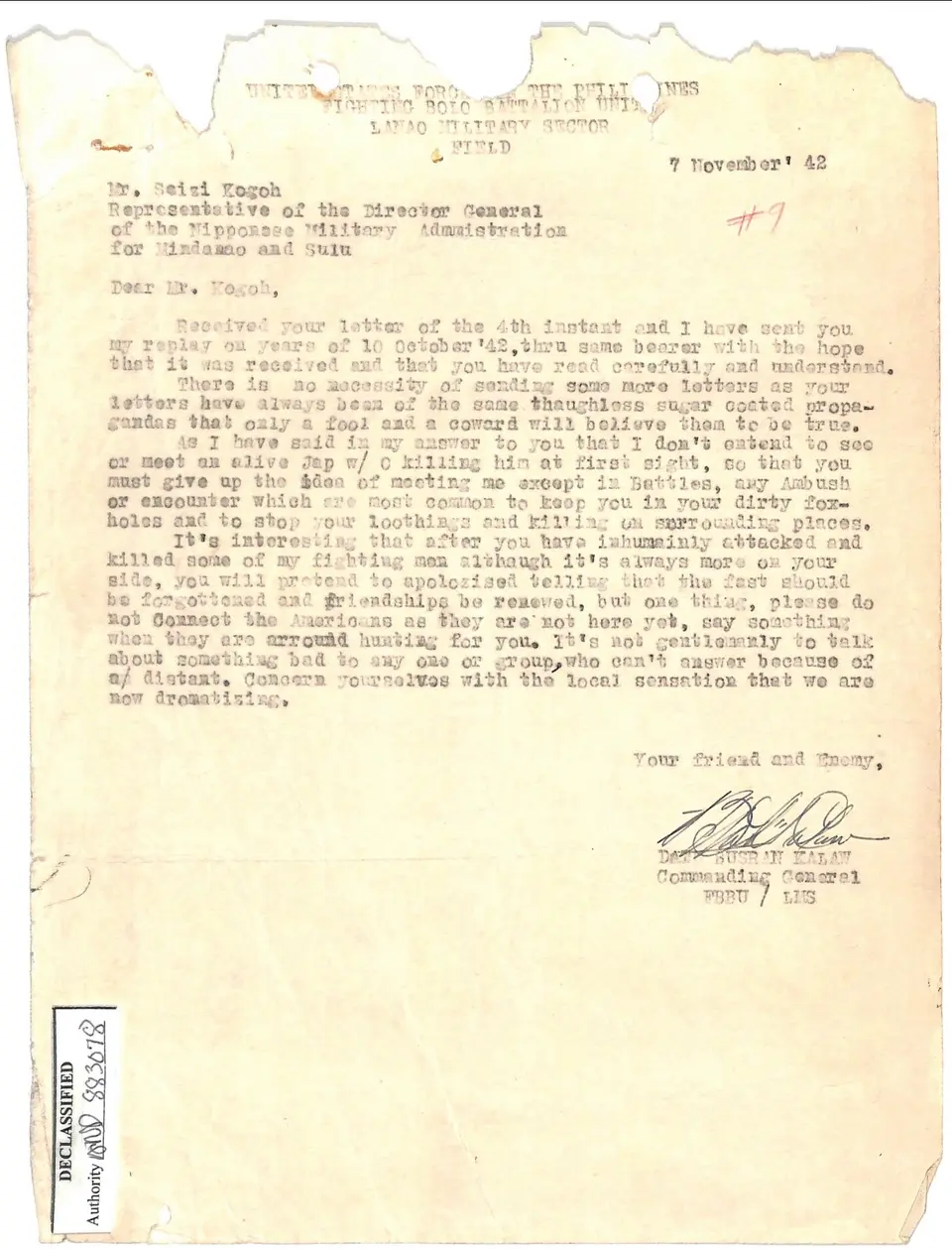 7 November 1942 – Reply from Datu Busran Kalaw to Mr. Seizi Kogoh
Full Verbatim Transcription:
UNITED STATES FORCES IN THE PHILIPPINES
FIGHTING BOLO BATTALION UNIT
LANAO MILITARY SECTOR
FIELD
7 November ’42
Mr. Seizi Kogoh
Representative of the Director General
of the Nipponese Military Administration
for Mindanao and Sulu
Dear Mr. Kogoh,
Received your letter of the 4th instant and I have sent you my replay on yours of 10 October ’42, thru same bearer with the hope that it was received and that you have read carefully and understand.
There is no necessity of sending some more letters as your letters have always been of the same thaughless sugar coated propagandas that only a fool and a coward will believe them to be true.
As I have said in my answer to you that I don’t intend to see or meet an alive Jap w/o killing him at first sight, so that you must give up the idea of meeting me except in Battles, any Ambush or encounter which are most common to keep you in your dirty foxholes and to stop your loothings and killing on surrounding places.
It’s interesting that after you have inhumanly attacked and killed some of my fighting men although it’s always more on your side, you will pretend to apolocised telling that the fast should be forgotten and friendships be renewed, but one thing, please do not Connect the Americans as they are not here yet, say something when they are around hunting for you. It’s not gentlemanly to talk about something bad to any one or group, who can’t answer because of a/distant. Concern yourselves with the local sensation that we are now dramatizing.
Your friend and Enemy,
(SGD) DATU BUSRAN KALAW
Commanding General
FBBU / LMS
14 November 1942 – Letter from Datu Busran Kalaw to Mr. Seizi Kogoh
Full Verbatim Transcription:
UNITED STATES ARMY FORCES IN THE PHILIPPINES
FIGHTING BOLO BATTALION UNIT
LANAO MILITARY SECTOR
FIELD
14 November ’42
Mr. Seizi Kogoh
Representative of General Morimoto
Director Gen. Military Administration
Mindanao and Sulu
Dear Mr. Seizi Kogoh,
I have your letter of 12 November ’42, just as I have yours of 8 November ‘42, too many within a short period, so that when I wrote sometimes ago stopping you to write thaughless letters, you begin writing almost every few days, not following my wish, however I’ll have to answer you just few words as an sport gentleman.
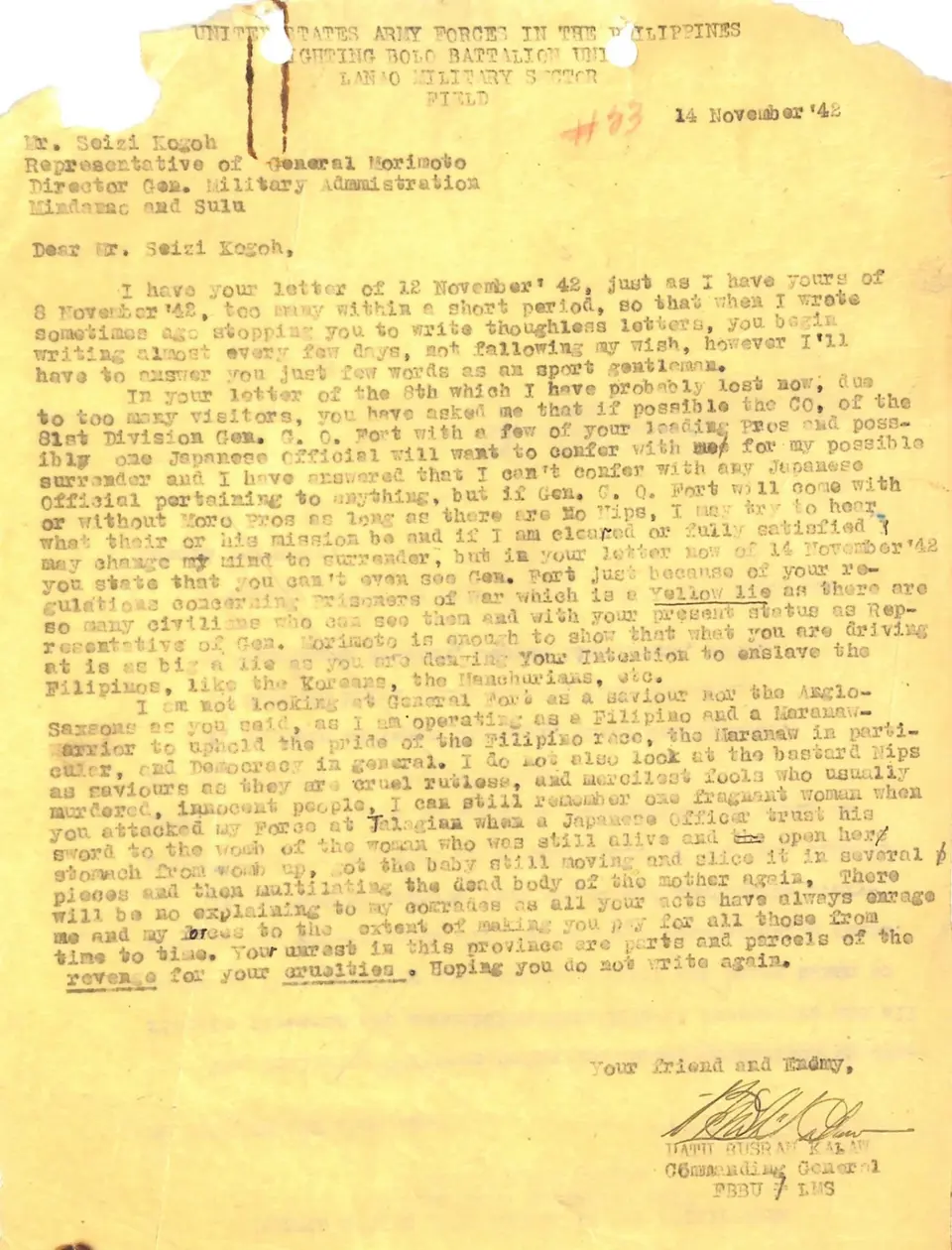 In your letter of the 8th which I have probably lost now, due to too many visitors, you have asked me if possible the CO, of the 81st Division Gen. G. O. Fort with a few of your leading Pros and possibly one Japanese official will want to confer with me for my possible surrender and I have answered that I can’t confer with any Japanese official pertaining to anything, but if Gen. G. O. Fort will come with or without Moro Pros as long as there are No Nips, I may try to hear what their or his mission be and if I am cleared or fully satisfied I may change my mind to surrender, but in your letter now of 14 November ‘42 you state that you can’t even see Gen. Fort just because of your regulations concerning Prisoners of War which is a yellow lie as there are so many civilians who can see them and with your present status as Representative of Gen. Morimoto is enough to show that what you are driving at is as big a lie as you are doing. Your intention to enslave the Filipinos, like the Koreans, the Manchurians, etc.
I am not looking at General Fort as a saviour nor the Anglo-Saxons as you said, as I am operating as a Filipino and a Maranaw-Warrior to uphold the pride of the Filipino race, the Maranaw in particular, and Democracy in general. I do not also look at the bastard Nips as saviours as they are cruel ruthless, and merciless fools who usually murdered, innocent people when you attacked my Force at Talagian when a Japanese officer trust his sword to the womb of the woman who was still alive and the open her stomach from womb up, out the baby still moving and slice it in several pieces and then mutilating the dead body of the mother again. There will be no explaining to my comrades as all your acts have always enrage me and my forces to the extent of making you pay for all those from time to time. Your arrest in this province are parts and parcels of the revenge for your cruelties. Hoping you do not write again.
Your friend and Enemy,
(SGD) DATU BUSRAN KALAW
Commanding General
FBBU / LMS
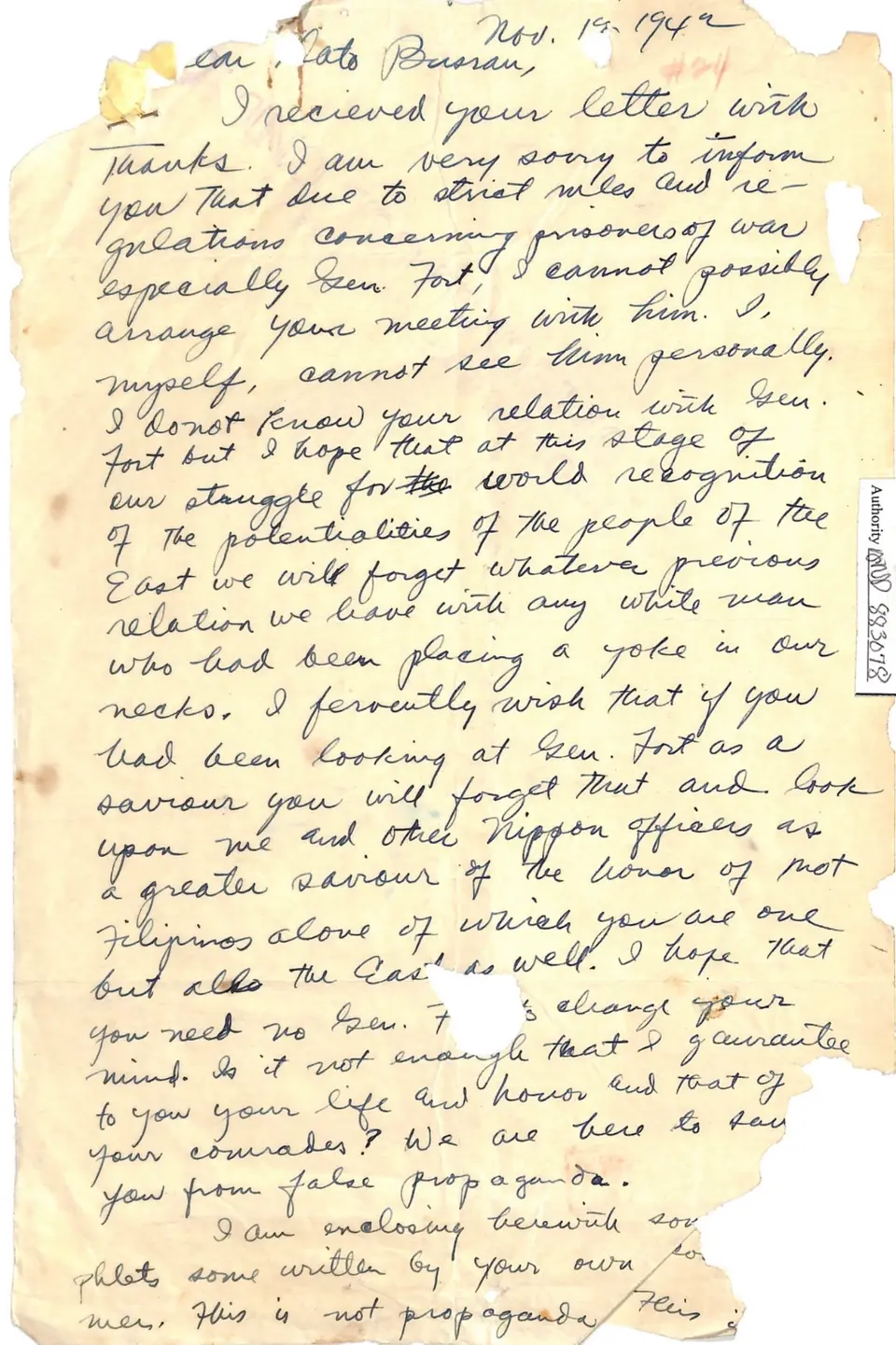 19 November 1942 – Handwritten Reply from Seiji Koga to Datu Busran Kalaw
Full Verbatim Transcription (both pages):
Nov. 19, 1942
Dear Datu Busan,
I received your letter with thanks. I am very sorry to inform you that due to strict rules and regulations concerning prisoners of war especially Gen. Fort, I cannot possibly arrange your meeting with him. I, myself, cannot see him personally.
I do not know your relation with Gen. Fort but I hope that at this stage of our struggle for the world recognition of the potentialities of the people of the East we will forget whatever previous relation we have with any white man who had been placing a yoke in our necks. I fervently wish that if you had been looking at Gen. Fort as a saviour you will forget that and look upon me 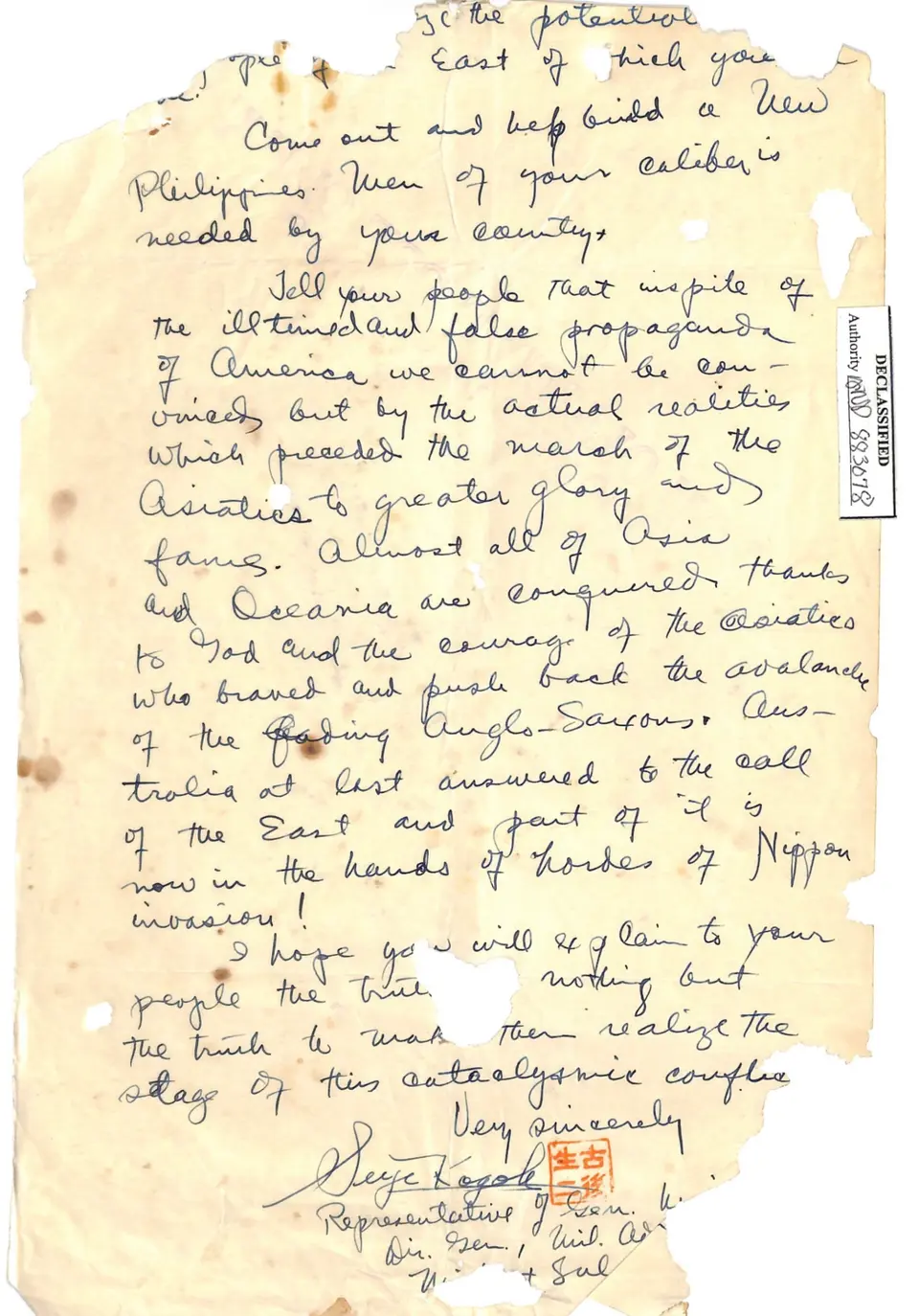 and other Nippon officers as a greater saviour of the honor of not Filipinos alone of which you are one but also the East as well. I hope that you need no Gen. Fort to enlarge your mind. Is it not enough that I guarantee to you your life and honor and that of your comrades? We are here to save you from false propaganda.
I am enclosing herewith some photos some written by your own men. This is not propaganda.
the potential of the East of which you are one. Come out and help build a New Philippines. Men of your caliber is needed by your country.
Tell your people that inspite of the illtimed and false propaganda of America we cannot be convinced but by the actual realities which preceded the march of the Asiatics to greater glory and fame. Almost all of Asia and Oceania are conquered. Thanks to God and the courage of the Asiatics who braved and push back the avalanche of the fading Anglo-Saxons. Australia at last answered to the call of the East and part of it is now in the hands of hordes of Nippon invasion!
I hope you will explain to your people the truth. nothing but the truth to make them realize the stage of this cataclysmic couple.
Very sincerely
Seiji Koga
Representative of Gen. H.
Dir. Gen., Mil. Ad.
Min. + Sul
Analysis of the October–November 1942 Exchange
Koga’s letters employ classic Japanese wartime propaganda techniques: ideological appeals to pan-Asian unity, personal guarantees of safety, and dismissal of American influence as “false propaganda.” Datu Busran’s replies are consistently combative, citing specific Japanese atrocities (including the Talagian pregnant-woman incident) and refusing any collaboration. The 14 November letter shows Datu Busran still pressing for a meeting with Fort three days after the execution. Koga’s 19 November handwritten reply maintains the deliberate deception that Fort was alive, while continuing the ideological pitch. This exchange, occurring against the backdrop of the FBBU’s documented guerrilla successes, underscores Tanaka’s loss of control and the ultimate futility of Japanese psychological operations in Lanao.
6. The FBBU Guerrilla Campaign: The Sustained Resistance That Made Pacification Impossible (May 1942–1943)
The correspondence in NND 883078 makes clear that Japanese propaganda failed to fracture Moro resistance. What the letters only hinted at, the FBBU’s own after-action reports and casualty ledger reveal in full: a sustained, highly effective guerrilla campaign that inflicted hundreds of Japanese casualties, repeatedly attacked Camp Keithley itself, destroyed key infrastructure, and rendered Lanao ungovernable. These operations, documented in the same declassified file, created the operational crisis that forced Lt. Col. Yoshinari Tanaka to retrieve Brig. Gen. Guy O. Fort and execute him at Camp Keithley on 11 November 1942.
6.1 Complete FBBU Casualty Ledger (signed Amundia Kalaw, Colonel Inf., Chief of Staff, FBWD LMS)
Full Verbatim Transcription of the Casualty Table:
UNITED STATES ARMY FORCES IN THE PHILIPPINES
FIGHTING BLADE WEAPON DIVISION
LANAO MILITARY SECTOR
APPROXIMATE CASUALTIES OF THE FBBU AND ENEMY
| Date | Place | FBBU Killed in Action | FBBU Wounded | Approximate Enemy Casualties: Dead | Wounded | Remark |
| 28 May ’42 | Saguiaran | None | None | 4 | None |
|
| 2 June ’42 | Keithley | “ | “ | 4 | 6 |
|
| 10 June ’42 | Pawak | 2 | 3 | 7 | 8 |
|
| 17 July ’42 | Masiu | 5 | 12 | 3 | 6 | Approx. E-C |
| 25 July ’42 | Keithley | - | 7 | 12 | 9 | “ |
| 10 Aug ’42 | Uato- | 26 | 31 | 4 | 12 | “ |
| 16 Aug ’42 | Abaga | - | 3 | 10 | 17 | “ |
| 9 Aug ’42 | Causwagan | - | - | 20 | - | “ |
| 10 Aug ’42 | Masiu | 5 | 8 | 16 | Unknown |
|
| 14 Aug ’42 | Pantar Bridge | 1 | 7 | 48 | “ |
|
| 29 May to 8 Aug ’42 | General Campaign | 102 | 39 | Unknown | Unknown | FBBU AND Civ. casualty (1) one Jap survived |
| 12 Sept ’42 | Tamparan | 37 | 32 | 178 | - |
|
| 21–23 Oct ’42 | Talob & Dalama | 11 | 4 | 124 | Unknown | Approx. E-C |
| 24–30 Nov ’42 | Keithley | 1 | 7 | 58 | “ | “ |
| 8 April ’42 | Pantar | - | 3 | 1 | 3 | Approx. E-C |
| 5 April ’43 | Kalanganan | 4 | 12 | 38 | Unknown | “ |
| July ’42 to April ’43 | Coastal | - | 6 | 16 | Unknown | Approx. E-C |
| 17 Oct ’43 | Last Attempt of Enemy to crush the FBBU & the 126th Inf Reg’tl HQ | - | 6 | 20 | 19 | Approx. E-C |
|
|
| 19 | 12 | - | - | Approx. Casualty due to Enemy air action |
TOTAL | | 211 | 198 | 543 | 80 | |
Signed: AMUNDIA KALAW
COLONEL INF. FBWD
Chief of Staff FBWD LMS
6.2 Full Verbatim After-Action Reports
Saguiaran (28 May 1942)
Fighting Bolo Battalion Unit, Lanao Military Sector, had begun, the Commanding General of the said organization ordered 12 of his men to attack and kill the Japanese soldiers who were patrolling in Saguiaran. Six of the attacking party approached four of the Japanese soldiers who were in a separate group and before they knew what will happen, the four Japanese soldiers were stabbed to death. The rest of the Japanese soldiers upon learning what happened to their comrades fired at our men who made good their escape with two Japanese rifles and some ammunitions. From this experience the Japs always grouped themselves while on patrol.
The FBBU Attacked Camp Keithley (2 June 1942)
On June 2, 1942, four groups of our fighting men posted themselves at a suitable place along the road that connects Camp Keithley and the poblacion of Dansalan. They waited until night fell. When the Japanese soldiers coming from the poblacion of Dansalan was passing by their hideouts, our men fired a volley against them and then ran for safety. The Japanese were not able to answer and our men suffered no losses. According to reliable information from our secret service men, four Japanese soldiers were killed.
The Pawak Ambush (10 June 1942)
It has been observed that the Japanese authorities used to send trucks to Iligan, one and sometimes two at a time. The Commanding General detailed Lt. Macalangcom Sabas and Lt. Calan-dada Sabas to attack and ambush the said trucks. These officers selected the sitio of Pawak where to wait for the truck to pass. They posted themselves including their men in this place and when the Japanese trucks was passing thru, they immediately fired at them. The Japanese soldiers in the trucks returned the fire but our men were well concealed. They sent another volley against the Japs in the trucks and the latter had to escape hurriedly. One of the trucks was left behind and the other truck continued the trip bringing their soldiers killed and wounded. According to data furnished by our secret service men, four Japanese officers and three enlisted men were killed in this attack. Enrage, the Japs burned all the buildings at Pawak and Pantar on the following morning and killed two and wounded three of the defenders. The Pawak ambush took place on June 10, 1942.
Japs on Patrol Attacked Masiu (17 July 1942)
On July 17, 1942, about two companies of Japanese soldiers riding on launches attacked Masiu. In this surprise attack, five of our men were killed and several were wounded. The commander of the regiment of the fighting bolo battalion unit in Masiu hurriedly gathered his men and fought back the Japanese patrol. The Japs and our fighting men fought at the lakeshore of Masiu. Our men inflicted slight losses on the enemy as they took their launches and rode away. The timely withdrawal of the Japanese patrol from the encounter saved them from complete annihilation as FBBU reinforcements were then pouring into the fight.
Japs Garrison at Camp Keithley Attacked (25 July 1942)
Enraged by the Japs Patrol attack of Masiu, our fighting men prepared for a reprisal attack on Camp Keithley. This was the second attack at Camp Keithley. On July 25, 1942, our men approached and surrounded the Japanese garrison, by creeping under cover of darkness towards those soldiers outside their barracks. There were seven groups who undertook this attack. When our men reached within range those Japanese soldiers who were scattered outside, they fired at them killing several of them in the spot. Our men were fired upon but only seven were wounded. The Japs ran to their foxholes so our men also withdrew. After this attack, the Japanese soldiers never dared to go out on patrol anymore. They began building their fortifications and trenches in Camp Keithley. They always keep themselves inside their fortifications whenever they learn and are certain the Fighting Bolo Battalion are around.
Japs Patrol Attacked Uato
When the Japs was passing the road from Malabang to Camp Keithley they were fired upon at the sitio of Cavagan, Tugaya, Lanao. Enraged by this incident, the Japs authorities sent a big Japanese patrol to Uato. They attacked Uato and burned all the houses at their path. Many civilians were killed as they were unprepared for the attack. That was at dawn of June 10, 1942, when the people was still sleeping. News about the attack reached the General Headquarters. The Commanding General hurriedly gathered his men and rushed to Uato to reenforce his Fighting Bolo Battalion Unit at Uato. When he arrived at Uato the Japs were already almost thru with their dirty work. They fought back the Japs who feeling that there was an organized resistance returned to their launches and rode away.
Jap Trucks Ambushed at Abaga (6 August 1942)
On August 6, 1942, a group of our Fighting Bolo Battalion Unit, under the command of Major Amundia Kalaw, ambushed several trucks going to Iligan at Abaga. After a short exchange of shots the trucks hurriedly proceeded to Iligan. In this ambush, the Japanese suffered 10 killed and several wounded. The data was furnished by our agents in Iligan. Our men suffered only three wounded.
Japs in Launches Driven Away at Caswagan, Iligan, Lanao (9 August 1942)
On August 9, 1942, the Japanese patrol coming from Iligan tried to land at Caswagan for the first time. Our men, under the command of William Tate and Natangcop Sumandar, fired at the Japs in the launches. The Japs fought back but after a half-hour fight, the launches turned away and failed to land. No casualty was suffered by our men.
The Japs Attacked Masiu Again (10 August 1942 – Talagian Atrocity)
On August 10, 1942, about two companies Japanese soldiers riding in launches arrived at Masiu. This time they attacked Bubong and Talagian, both in the municipal district of Masiu. In this attack, they killed two women and one old man. One of the women was pregnant nearing delivery. The Japanese commander of the patrol thrust his sword on her genital organ while she still alive and took out the child from her womb and sliced it into pieces, after which the dying mother was again bayoneted by the rest of the soldiers. Enemy casualty was heavy after the FBBU reenforcement from other regiments arrived. Despite bombing and straffings by the airplanes supporting the enemy patrol, our men rushed like mad dogs at the Japanese soldiers, prompted by their desire to kill even only Jap so that they capture his firearm which they considered a good war trophy.
The Battle of Pantar Bridge (14 August 1942)
The Commanding General was very eager to lead the attack at the garrison of the Japanese at Camp Keithley. But before attempting on the attack, he decided to destroy first the Pantar Bridge so that Japanese reenforcement from Iligan cannot help and reenforce the garrison in Camp Keithley. Help from the Japanese garrisons at Malabang and Ganassi cannot be expected by the Japanese in Camp Keithley as all the bridges between these places and Camp Keithley were all destroyed by our men. August 14, 1942, was set as the date when to destroy the Pantar Bridge. The Commanding General, his Chief of Staff Amundia Kalaw, William Tate, his Executive Officer Kintawan Lidangan and some 80 picked men took their respective positions before sending the group to burn and destroy the Pantar Bridge.
Upon the arrival of the Commanding General and his men near the bridge, they were surprised to find so many Japanese soldiers watching the bridge. Turning around the Commanding General and his men were surrounded by Japs soldiers at the upper clips of the road. The Japs began firing, so we had to seek cover. Judging from the directions from which the firing comes, the Commanding General believed and can easily see that on both sides of the Agus River the enemy had placed most of their powerful arms. The enemy tried to cross the bridge in order to get near our positions. We fired at them when they reached the middle of the bridge and we saw plainly the Japs falling into the river and were carried downstream. The enemy had to retreat so we waited for their second attempt to cross the bridge. This time the Japanese soldiers tried to cross the bridge on two trucks. They succeeded but before they were able to cross the bridge, we fired at them again and the two trucks fell into the ditch throwing its contents out.
The fight began at 8:00 o’clock in the morning and it lasted until 3:00 o’clock in the afternoon. Our ammunitions was running low and I ordered our retreat. One of our men was killed and seven were wounded in this fight. The enemy’s casualty was later reported by our secret service men to be 40 Japs killed besides those who dropped and fell into the Agus River, and several were wounded. We failed to burn the bridge. The Commanding General sent his men to buy ammunitions as they were already exhausted with ammunitions.
178 Japs Killed at the Tamparan Fight (12 September 1942)
On the date the writer sent his reply to the Jap Commander-in-Chief, he left with 90 picked fighting men for Tamparan. True to his expectation, reports reached him in Tamparan that a Japanese patrol was being sent to catch him as they called it. The writer, therefore, sent runners to the different regiments in the neighboring places with instruction to get ready to meet the Japanese patrol.
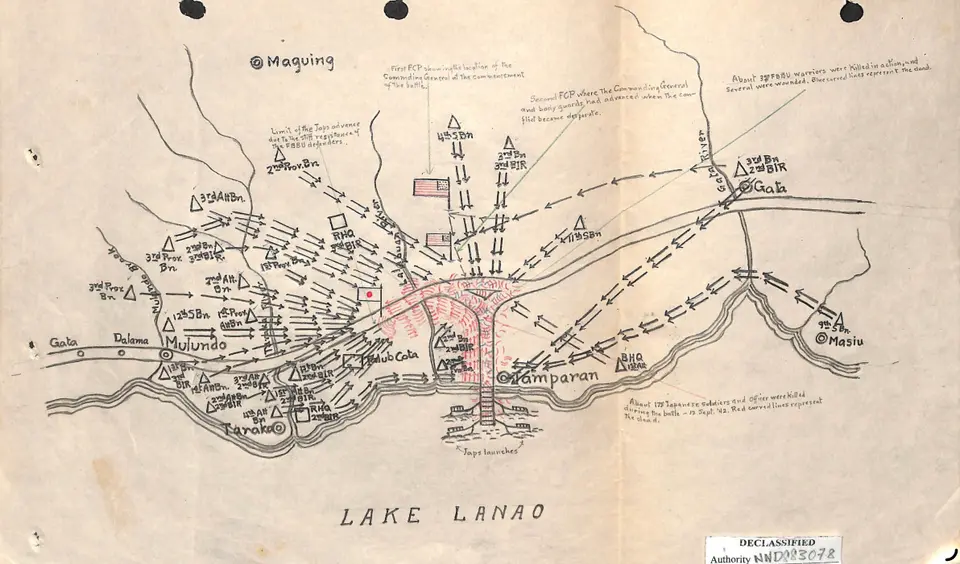 On September 12, 1942, the Japanese patrol arrived. The fighting men in the sector with their firearms and weapons were deployed in their respective places. The Japs landed at the Tamparan lakeshore unmolested. When they have penetrated farther inside and while they were within range, the fighting men fired at them without mercy. Our fighting men advanced at them until both forces met. With firearms, campilans, krises and bolos our men easily defeated and killed 178 Japanese soldiers in less than two hours. On the side of the Fighting Bolo Battalion Unit, there were 37 men killed and 32 men wounded. With this signal victory over the Japanese in Tamparan, under the personal direction of the Commanding General in the battle field, the morale of the Fighting Bolo Battalion Unit, Lanao Military Sector, was very high. Great was the rejoicing of the fighting men and the firearms and ammunitions, sabers and other Japanese weapons were captured. The four launches wherein the Japanese rode to Tamparan were all burned.
The writer, Commanding General of the Fighting Bolo Battalion, after inspecting the dead bodies of the enemies, as well as the corpse of our fighting men killed and those who were wounded, ordered all the commanders of the organization in these places to prepare for the next Japanese attack which the writer was positive it will surely come soon. It was the intention of writer to return to the General Headquarters at Batal, Momungan, in order to start the preparation for the final attack on the Japs garrison at Camp Keithley.
Japs Reprisal – Bombings and Straffing
The writer stayed in Tamparan two more days and during these days, bombings and straffings were daily occurrence in Tamparan and the neighboring districts. Many houses, big and small, in Tamparan were hit by the bombs and many were killed and wounded by the straffing.
The writer arrived at his General Headquarters at Batal, only to find the surrounding places being bombed by the enemy’s planes. They were after the destruction of the General Headquarters but unluckily on the part of the Japanese pilots, they unhappily missed their mark and hit only the empty forests.
The Battle of Talob, Tamparan (21 October 1942)
The Fighting Bolo Battalion Unit, despite the daily activities of the enemy’s planes, did not cool off. Instead, whenever an enemy’s plane comes hovering over them, they shouted vengeance at the planes brandishing their weapons. They got used to the planes and they never seek-cover when the plane is coming. Their pride in the annihilation of the Japs in Tamparan is still fresh in their minds and they are eager for more fight.
The Japs can never forget what happened to them in Tamparan. They wanted to show to the people of Lanao that they could yet be the ruler of Lanao. They prepared a punitive expedition against the people who killed their comrades. In order to hide its purpose, they branded the expedition as a mere patrol to pay homage to their fallen companions. But the Fighting Bolo Battalion Unit got wise and they prepared for battle.
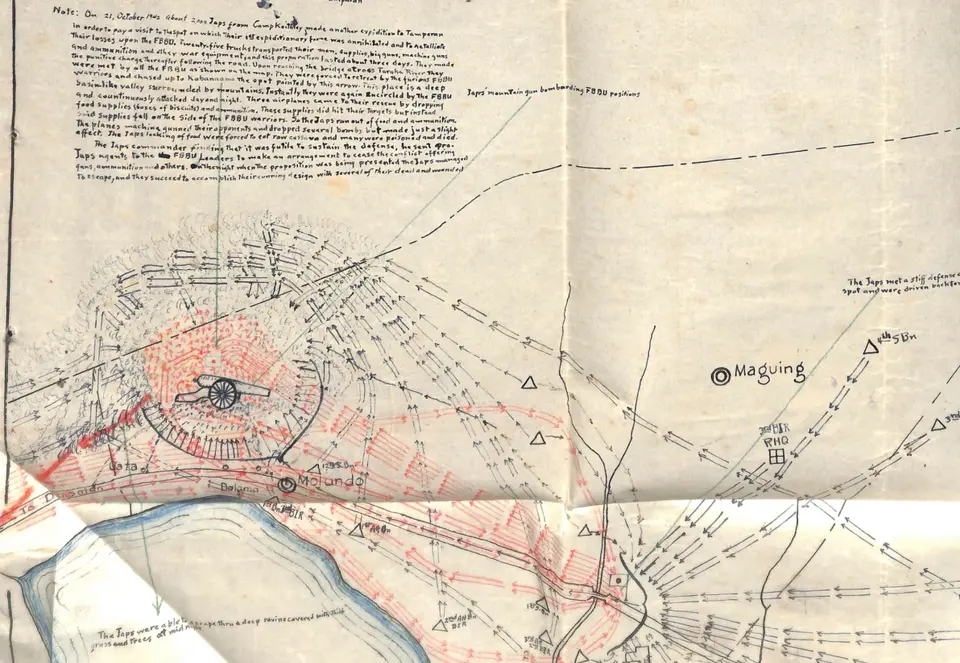 On October 21, 1942, several trucks fully loaded with soldiers of approximately more than two thousand officers and men and all kinds of firearms, big and small, supported by three airplanes, were fast approaching Taraka in three spearheaded by three columns. Our men posted themselves at an appropriate distance from the road in and around Talob Cota. They waited for the enemy to pass.
The enemy did not continue their march to Tamparan but contented themselves to stop in Taraka. In this place they poised their big guns towards our men in Talob Cota and poured as much shells as they could afford. Our men only answered them with shouts and a few rifle shots. They enemy’s planes also dropped bombs and strafed our men’s positions. They answered only with shouts and the beating of their “Agongs” – a moro drum made of brass. For unknown reasons, the Japs retreated to Dalama Hill and encamped themselves in Caban-amo, a valley surrounded by small hills and forests. Our men followed them and within a short time the Japs position was surrounded. Despite rains of bullets and mortars from the ground forces and bombs and straffings from the enemy’s planes, our men, very eager to kill his Jap, slowly but unceasingly and inch by inch, they approached the enemy entrenched at the Dalama Hill. Our men were able to reach the hills and forests surrounding the enemy. Around the enemy they deployed themselves carefully and began firing when occasion demands.
The enemy running short of food supplies have been forced to dig poisonous cassava roots and after eating these tubers many of them died. The planes were used in bringing the enemy surrounded at Caban-amo their food by dropping boxes of biscuits. These boxes sometimes were dropped at our men’s positions and they happily feasted on them. The fight lasted for five days. The shortage of food became more acute on the part of the enemy as there was no time to look for food nor there was anybody who will give them food. So on the night of the fifth day of the fight, under cover of darkness and forests, the Japanese expeditionary forces, fearing that their expedition might repeat the Tamparan Tragedy, made good their escape after burning many houses along their way back to their garrison at Camp Keithley. The Fighting Bolo Battalion Unit suffered sixteen men killed and wounded, while the Japanese suffered five truck-loads of killed soldiers and several wounded.
This fight ended the Japanese policy of subjugation in all the districts around the lake. The Japs never attempted to go out patrolling in these regions. The Japs learned a great lesson that the Maranaos are nuts hard to crack. The Japs dug in and were on the defensive side. The Fighting Bolo Battalion Unit, Lanao Military Sector, knew this and they made preparations to attack the different Japanese garrisons besides ambushes.
6.3 Analysis of the Guerrilla Campaign
The FBBU’s documented operations — from the first kill at Saguiaran on 28 May 1942 through the major victories at Tamparan (178 Japanese killed) and Talob/Taraka — created unrelenting pressure that Tanaka could not counter with propaganda or conventional force. The repeated attacks on Camp Keithley itself, the destruction of bridges, and the heavy casualties forced Tanaka to escalate dramatically by bringing the captured General Fort back to Camp Keithley for execution on 11 November 1942. The 14–19 November correspondence, occurring in the immediate aftermath of these battles, shows the Japanese still attempting deception because the Lanao situation remained completely uncontrollable.
7. Postwar Testimony and Contradictions
The primary-source documents preserved in NND 883078 provide contemporaneous, irrefutable evidence that directly contradicts postwar Japanese testimony. This pattern of minimization, timeline manipulation, and self-protection by mid-level officers involved in the Fort case is a textbook example of how Japanese personnel sought to obscure command responsibility after the war.
Maj. H. Hiramatsu’s 1948 GHQ-SCAP Interrogation
In his sworn statement to General Headquarters, Supreme Commander for the Allied Powers (Legal Section, Tokyo, July 1948), Hiramatsu claimed he arrived in Dansalan only in September 1942, was still recovering from malaria contracted in April, performed “no full duties” until December 1942, and had “nothing whatsoever to do with” the execution of Fort except to watch it passively from approximately 50 yards away on a small hill. He stated that Lt. Nakamura fired two rifle shots on Tanaka’s order and even drew a map marking the “X EXECUTION” site at the battalion firing range.
Lt. Col. Yoshinari Tanaka’s Yokohama Trial Testimony (Case ICWC21045)
Tanaka directly contradicted Hiramatsu. He admitted ordering the execution and testified that Hiramatsu was actively involved: Hiramatsu gave the “fire” command and personally delivered the fatal saber stab (coup de grâce) after Fort was shot but not killed instantly. Tanaka stated that Fort had been blindfolded and brought back to Dansalan specifically for this purpose.
Petronio C. Encabo’s Sworn Affidavit (Dansalan, 14 November 1946)
The most detailed independent eyewitness account comes from Petronio C. Encabo, a Filipino POW who worked inside the Japanese Intelligence Office at Camp Keithley. Encabo described the events of 11 November 1942 in minute detail: a propaganda stencil bearing Fort’s forged signature was prepared in the office; officers selected sabers; a command car with a red banner arrived carrying Major Hiramatsu; Fort was paraded tied to a truck; and the convoy moved toward the execution area. The vehicles returned about an hour later without Fort.
Direct Refutation by NND 883078 Documents
The June 1942 Hiramatsu propaganda leaflet and Aminita Kalaw’s 30 June 1942 reply prove Hiramatsu was already functioning as Chief of Staff and running active psychological operations against the FBBU three months earlier than he claimed. The complete casualty ledger and after-action reports further demonstrate that the FBBU was inflicting heavy losses on Japanese forces throughout the summer and fall of 1942, directly contradicting Hiramatsu’s assertion of limited involvement.
Hiramatsu’s hand-drawn map places the execution site at the firing range on the wrong side of the road to Iligan City. Current AMAG investigative efforts, guided by independent accounts (Encabo, Tanaka) and 1945 aerial imagery of Camp Keithley, prioritize corridors consistent with those accounts rather than Hiramatsu’s self-serving map.
These contradictions illustrate a textbook example of postwar self-protection by mid-level Japanese officers. Hiramatsu minimized his personal role, pushed his timeline forward, and provided a map that directs attention away from the areas now under active consideration by the recovery team. The primary documents in NND 883078 expose the gap between his claimed inactivity and his actual responsibilities as Tanaka’s intelligence chief and propaganda author.
8. Comprehensive Analysis: Tanaka’s Loss of Control and Fort’s Return to Keithley
The cumulative evidence in NND 883078 demonstrates that Lt. Col. Yoshinari Tanaka lost operational control of the Lanao region despite an intensive, multi-month propaganda and outreach campaign. The failure of that campaign, combined with the FBBU’s documented guerrilla successes, created the crisis that led directly to Fort’s return to Camp Keithley and execution on 11 November 1942.
Propaganda Failure
Tanaka, Hiramatsu, and Koga sent repeated letters (June through November 1942) offering collaboration, personal guarantees of safety, and ideological appeals to pan-Asian solidarity. Every letter was met with defiant rejection. Datu Busran Kalaw consistently refused meetings, issued formal combat challenges, cited specific Japanese atrocities (including the Talagian pregnant-woman incident), and reaffirmed loyalty to Fort and the United States. The 14 November 1942 letter shows Datu Busran still pressing for a meeting with Fort three days after the execution, forcing Koga’s deceptive 19 November reply.
Guerrilla Success
The FBBU casualty ledger and after-action reports document relentless operations: Saguiaran (28 May), Keithley (2 June and 25 July), Pawak (10 June), Masiu/Talagian (10 August — with the documented atrocity), Pantar Bridge (14 August), Tamparan (12 September — 178 Japanese killed), Talob/Taraka (21 October — multi-day battle against 2,000+ troops), and multiple 1943 actions. Grand totals: 543 Japanese dead, 80 wounded. These engagements repeatedly targeted Camp Keithley itself and key infrastructure, making conventional control impossible.
Tanaka’s Decision to Bring Fort Back to Keithley
It was Tanaka, acting through Seiji Koga — Director General of the Japanese Military Administration for Mindanao and Sulu and representative of Gen. Morimoto — who made the decision to bring Fort back to Camp Keithley. The purpose was to force the captured general to convince the Moros (particularly Datu Busran Kalaw and the FBBU) to surrender. When Fort refused, he was executed.
Notably, Seiji Koga himself was never implicated in the execution, nor was his commanding general or organization. Koga’s role remained limited to propaganda and psychological operations; the decision to retrieve and execute Fort was Tanaka’s operational choice, carried out through the military chain of command rather than the civil/military administration apparatus headed by Koga and Morimoto.
The Decision to Retrieve and Execute Fort
By November 1942, with propaganda exhausted and guerrilla pressure unrelenting, Tanaka brought the captured General Fort back to Camp Keithley. Independent accounts (Encabo affidavit and Tanaka’s trial testimony) confirm Fort was paraded and executed after refusing to order the FBBU to surrender. Koga’s 19 November letter — written eight days after the execution — continued the deception because the Lanao situation remained completely uncontrollable.
Strategic Failure
The Greater East Asia Co-Prosperity Sphere rhetoric collapsed against deeply rooted Moro autonomy and the personal command relationship established by Fort’s 21 May 1942 order. The FBBU’s sustained campaign proved that Japanese propaganda could not overcome the alliance between American/Philippine leadership and indigenous forces.
9. Significance for AMAG Fort MIA Recovery
NND 883078 provides the strongest contemporaneous documentary context yet for Fort’s execution site and the operational environment surrounding it.
- It validates prioritizing search corridors consistent with Encabo’s affidavit, Tanaka’s trial testimony, and FBBU after-action reports (particularly the repeated attacks on Camp Keithley and the Talagian/Pantar areas) over Hiramatsu’s self-serving map.
- The detailed casualty ledger and battle narratives supply precise dates, places, and casualty figures that can be cross-referenced with Japanese unit records and oral histories from Lanao veterans.
- The 14–19 November correspondence proves Japanese deception continued after the execution, explaining why families and early investigators received false information about Fort’s status.
- The file’s integrity (all documents stamped NND 883078) makes it a cornerstone for DPAA submissions and family briefings.
Immediate Implications for Recovery Operations
Current AMAG field efforts should focus on areas consistent with the FBBU accounts of Keithley attacks and the Talagian/Pantar engagements rather than Hiramatsu’s map. Oral history collection from Kalaw descendants and Lanao Maranao veterans should be prioritized to corroborate exact execution-site details. Any surviving enclosures referenced in Koga’s 19 November letter (photos and writings) should be located in the full file for additional context.
10. Conclusion
File NND 883078 stands as one of the most remarkable surviving records of Japanese occupation tactics and indigenous resistance in the Philippines. It documents, in real time, the complete failure of propaganda to break the Fort–Datu Busran alliance, the relentless FBBU guerrilla campaign that inflicted hundreds of Japanese casualties, and the Japanese deception that continued even after Fort’s execution on 11 November 1942.
Datu Busran Kalaw’s unyielding defiance — rooted directly in Fort’s 21 May 1942 order and sustained through dozens of documented battles that inflicted massive Japanese casualties — forced Tanaka’s hand. The decision to retrieve and execute Fort at Camp Keithley was not routine POW handling; it was a desperate escalation born of operational collapse, executed by Tanaka through the military chain while Seiji Koga’s administration apparatus remained focused on propaganda and was never implicated in the killing itself. Koga’s 19 November handwritten letter, written eight days after the killing, remains the clearest proof of deliberate Japanese deception.
For the Fort family, the POW/MIA community, and researchers seeking closure, these documents are not merely historical artifacts. They explain why earlier searches based solely on Japanese postwar statements produced limited results and why the current AMAG effort continues to cross-reference all available accounts. The file leaves no doubt: Fort was returned to Keithley because the Lanao situation was uncontrollable. The Moro resistance he helped empower ultimately sealed his fate while preserving the honor of the Philippines and the Allied cause in Mindanao.
John Bear
Chief of Investigative Research
Asymmetric MIA Accounting Group (AMAG)
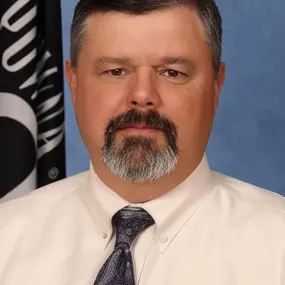
Investigative Researcher & Host of Stories of Sacrifice Podcast
John Bear is an accomplished investigator and forensic genealogist with over 20 years of experience specializing in World War II, Korea, and Vietnam War POW/MIA cases. He has honed forensic-level skills in open-source intelligence (OSINT) and archival research, bolstered by coursework in Advanced Research Methods and Databases for Historians. Inspired by the loss of his uncle, a WWII POW/MIA identified posthumously in the Philippines, John volunteers directly with families of the missing to provide answers and closure. As a key member of the Asymmetric MIA Accounting Group (AMAG), he works directly with MIA families to support projects alongside Military Service Casualty Officers, DPAA Historians, and military intelligence experts. Through his contributions to the Cabanatuan POW Camp, Philippine Hellship Project, and Bataan Death March, John’s efforts have led to over 350 potential WWII identifications through Family Reference Sample (FRS) DNA collection. His investigation into the Vietnam War’s Baron 52 incident uncovered compelling OSINT-based evidence suggesting crew survival, and his work on WWII unrecovered MIAs on Mindanao has generated critical leads. Through his podcast, Stories of Sacrifice: American POW/MIAs, John amplifies families’ stories, ensuring the legacies of the missing are honored.
Baron 52 Docu series Podcast Link: https://www.storiesofsacrifice.org/category/baron-52/
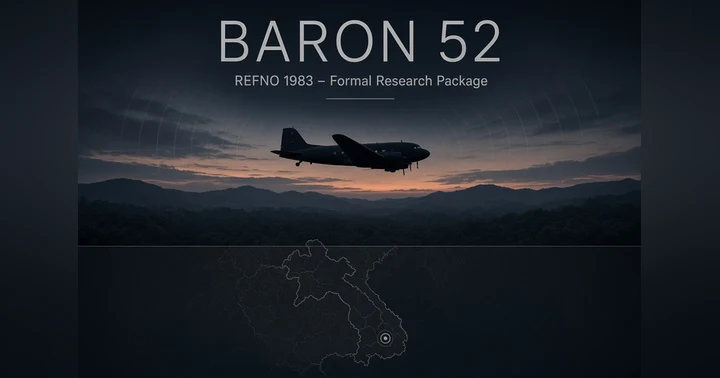
Baron 52: New Vietnamese Sources and the Case for Technical Review


