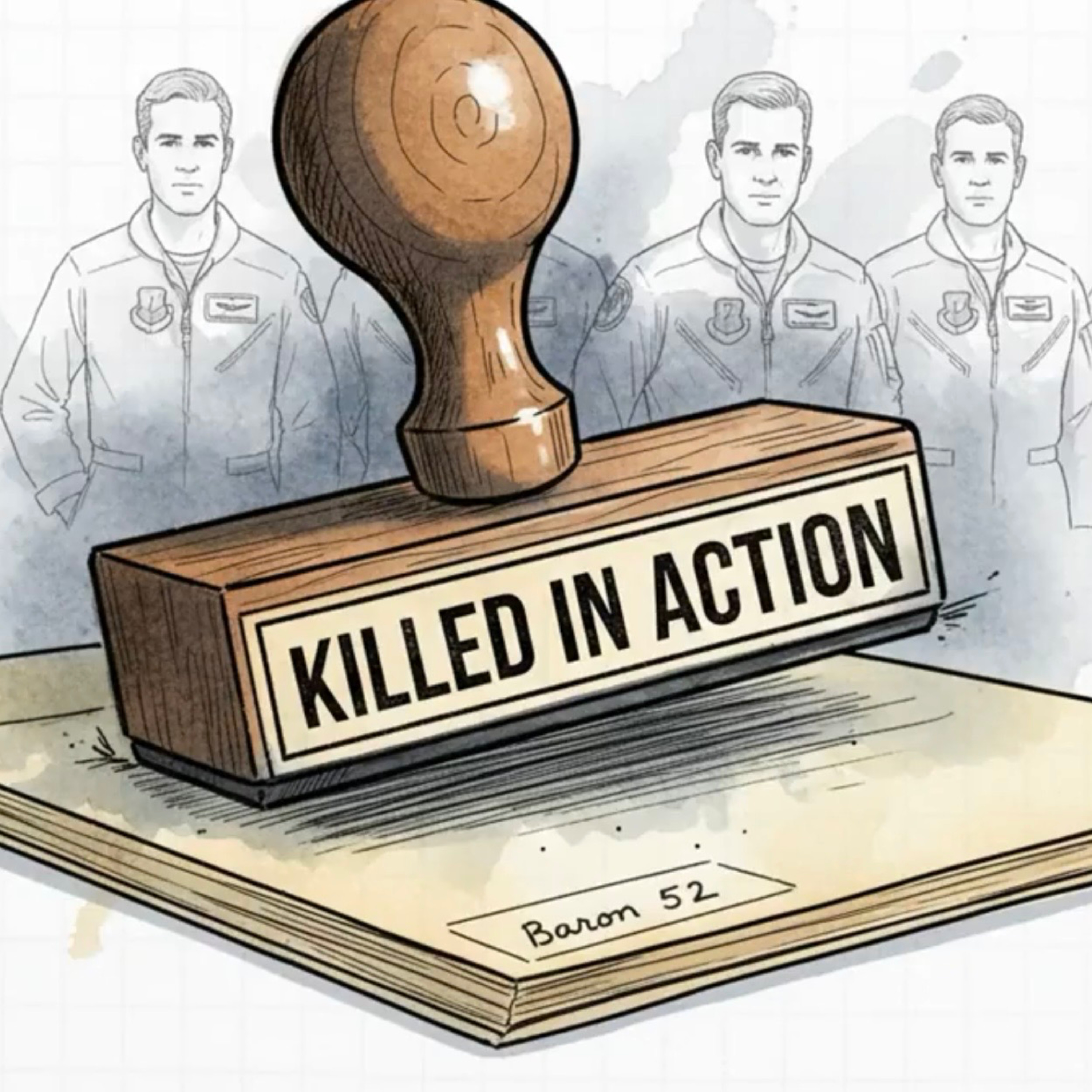
Reassessing the Baron 52 Intercepts (REFNO 1983): Consistent PAVN Use of “Pirate Pilots” Terminology in 1970–1972 Shootdowns Refutes the DPAA “Lao Irregulars” Interpretation
Author: John Bear – Chief of Investigative Research, Asymmetric MIA Accounting Group (AMAG)
Date: April 16, 2026
Abstract
Declassified NSA intercepts from 5 February 1973 (REFNO 1983 / Baron 52) report Group 210/217 “holding four pilots captive” and moving “four pirates” from Km 44 under Lt. Col. Luong Khanh Van. DIA analyst Robert J. DeStatte (1996) and the 2016 DPAA review (Bentz) dismissed these as references to Lao irregulars (“phi” / bandits) captured near Vinh. This paper demonstrates that the generic PAVN term “pirate pilots” / “pilots” / “pirates” was used consistently across multiple Binh Tram and AAA units in the Ho Chi Minh Trail network (including Binh Tram 35) in 1970–1972 to describe confirmed U.S. Air Force aircrew from several shootdowns. The wired Ky Son switchboard relay and Vinh Window collection mechanics explain the apparent “Vinh origin” while confirming the geographic source as southern Laos (Tang Cat / Route 128 corridor). The 1970 precedent, combined with unit continuity and communications infrastructure, refutes the Lao irregulars hypothesis.
1. Introduction
The Baron 52 incident (EC-47Q, 5 February 1973) remains one of the most contentious unresolved POW/MIA cases from the Vietnam War. Official accounting concluded that all eight crew members perished on impact, yet declassified SIGINT strongly indicates that the four back-end electronic warfare specialists survived and were captured. Central to the dispute is the interpretation of two NSA multichannel intercepts collected through the “Vinh Window.” This paper uses contemporaneous 1970–1972 NSA intercepts from multiple PAVN units operating in the same southern Laos / Ho Chi Minh Trail corridor to establish that the term “pirate pilots” / “pilots” / “pirates” was standard slang for U.S. airmen, not Lao irregulars.
2. Pattern of PAVN Terminology in Multiple Shootdown Reports (1970–1972)
The NSA POW/MIA Correlation Studies contain repeated examples of the generic PAVN term “pirate pilots” / “pilots” / “pirates” (or the closely related “bandit pilots”) in after-action reports for confirmed U.S. aircraft shootdowns. These reports come from various AAA battalions and Binh Tram units across the southern Laos / tri-border area, demonstrating an established network-wide reporting pattern.
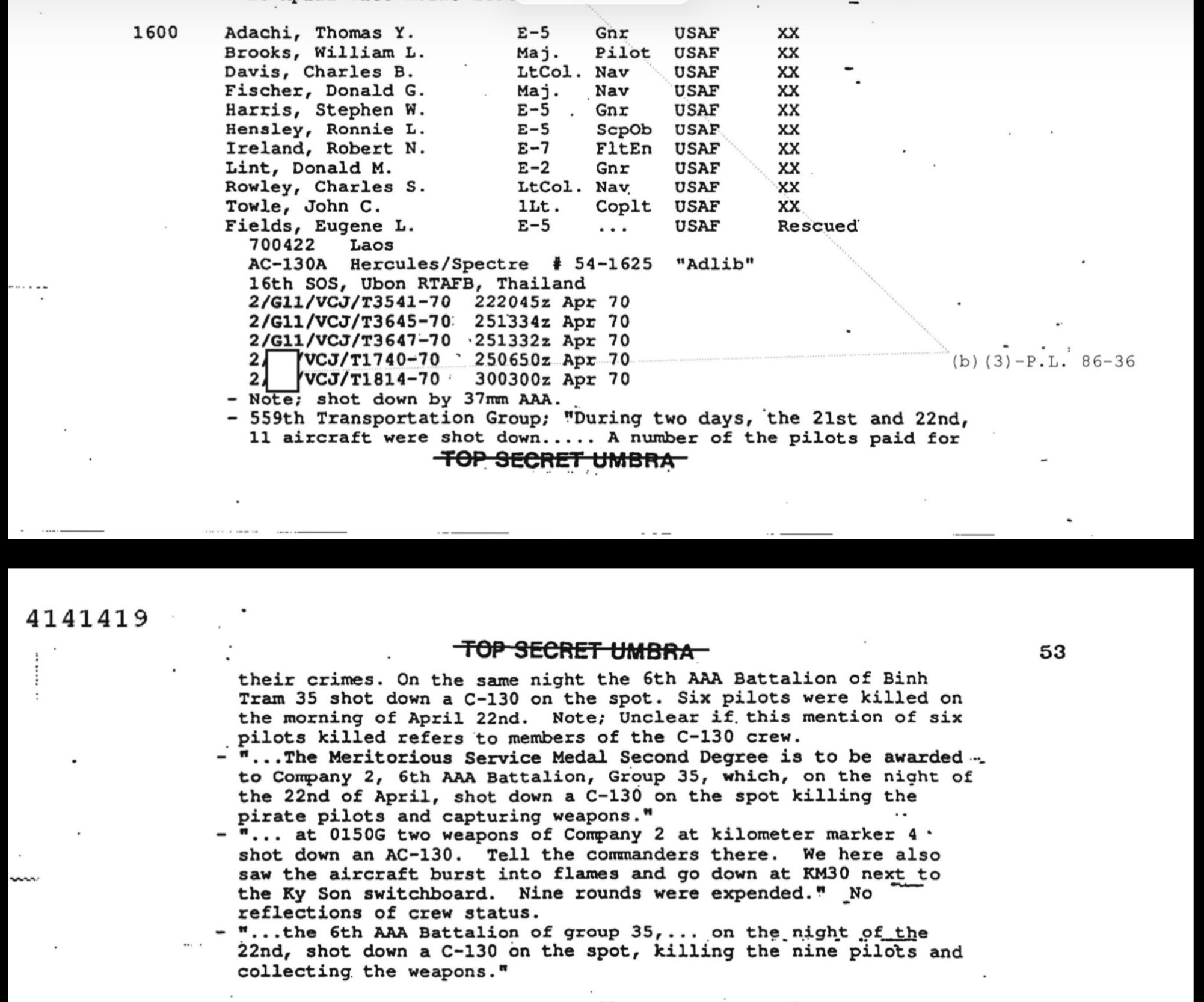
- REFNO 1600 (AC-130A “Adlib,” 22 April 1970): 6th AAA Battalion, Binh Tram 35 (559th Transportation Group) reported “killing the pirate pilots” and “killing the nine pilots” after the aircraft went down at KM30 next to the Ky Son switchboard. (Document 4141419, p. 53; analyst note: “No reflections of crew status.”)
- REFNO 1895 (Frank C. Green, A-4F Skyhawk, 10 July 1972): “Our air force shot down two aircraft and captured the pirate pilots alive.”
- REFNO 1897 (Frederick Masterson & Robert Randall, F-4J Phantom, 11 July 1972): Correlated intercepts use identical “pirate pilots” phrasing for two aircraft shot down.
- REFNO 1698 (Norbert Gotner & Robert Standerwick, F-4D Phantom, February 1971): “Company 1 of the 123rd Battalion… captured the pirate pilots alive.”
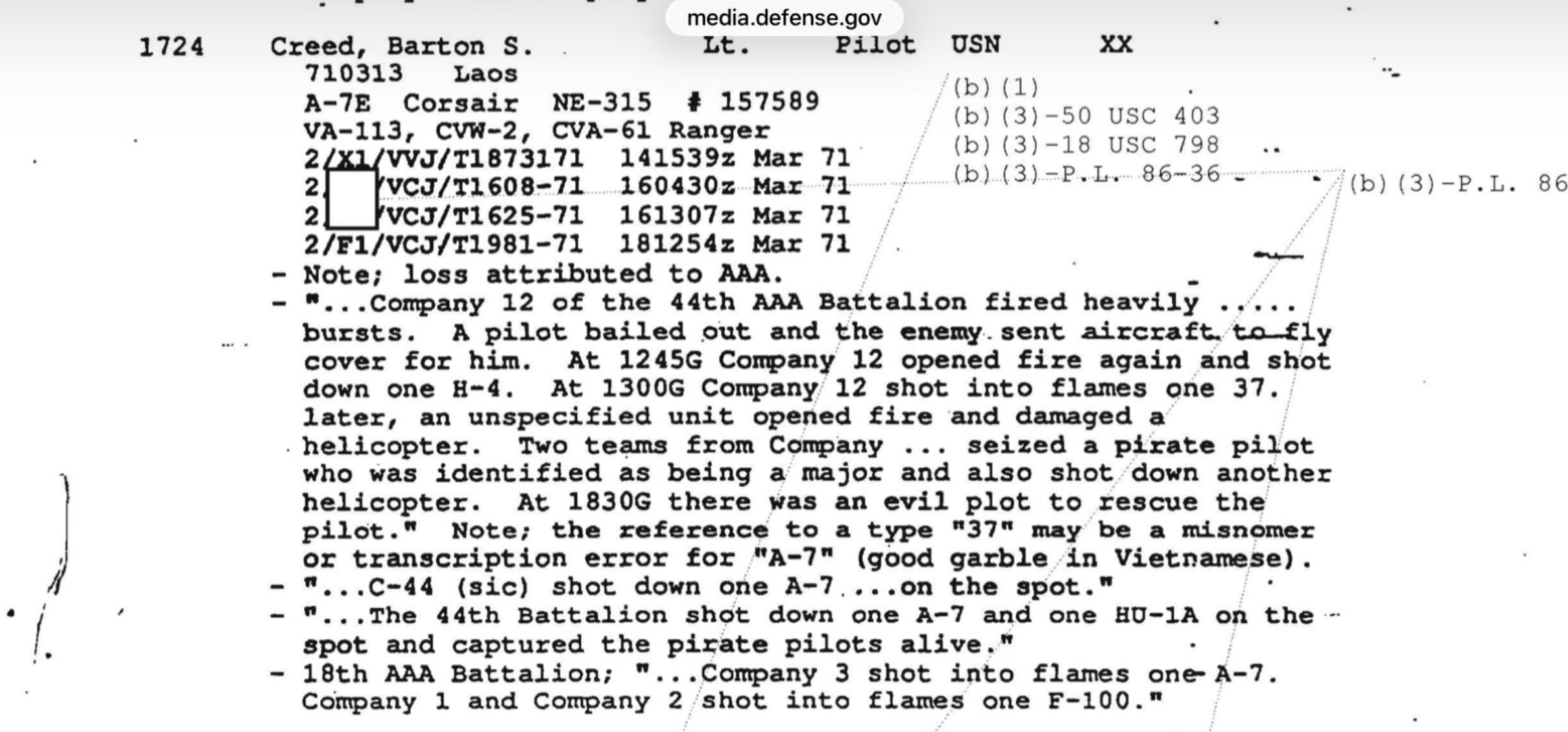
- REFNO 1724 (Barton Creed, A-7E Corsair, March 1971): “Two teams from Company… seized a pirate pilot who was identified as being a major.”
These examples (and others in the Correlation Studies) show the terminology was routinely applied to U.S. aircrew — killed or captured — by AAA and Binh Tram units operating along the Trail. It was not limited to Binh Tram 35, nor was it reserved for Lao irregulars.
3. Baron 52 Intercepts (REFNO 1983): Identical Terminology in the Same Corridor
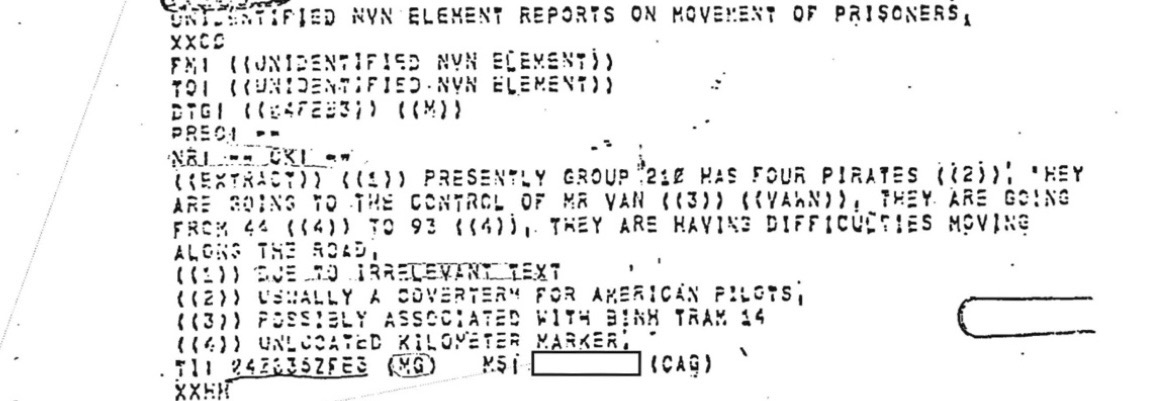
The 5 February 1973 intercepts (2/R0/182-73 and 2/R0/186-73) state:
“Group 217 … is holding four pilots captive and the group is requesting orders concerning what to do with them from an unid unit prob subordinate the 559th.”
“Presently Group 210 has four pirates … they are going to the control of Mr Van … from 44 to 93.”
NSA footnotes confirm “pirates” as the standard cover term for American pilots. NSA Correlation Studies (1992, 1993, 1996) explicitly linked these to Baron 52. A 2008 NSA retranslation placed the movement inside the southern Laos Trail corridor (Tang Cat / Route 128 sector) — the exact operational area where the 1970–1972 “pirate pilots” terminology appears repeatedly.
4. Communications Infrastructure: Ky Son Switchboard and the Vinh Window Relay
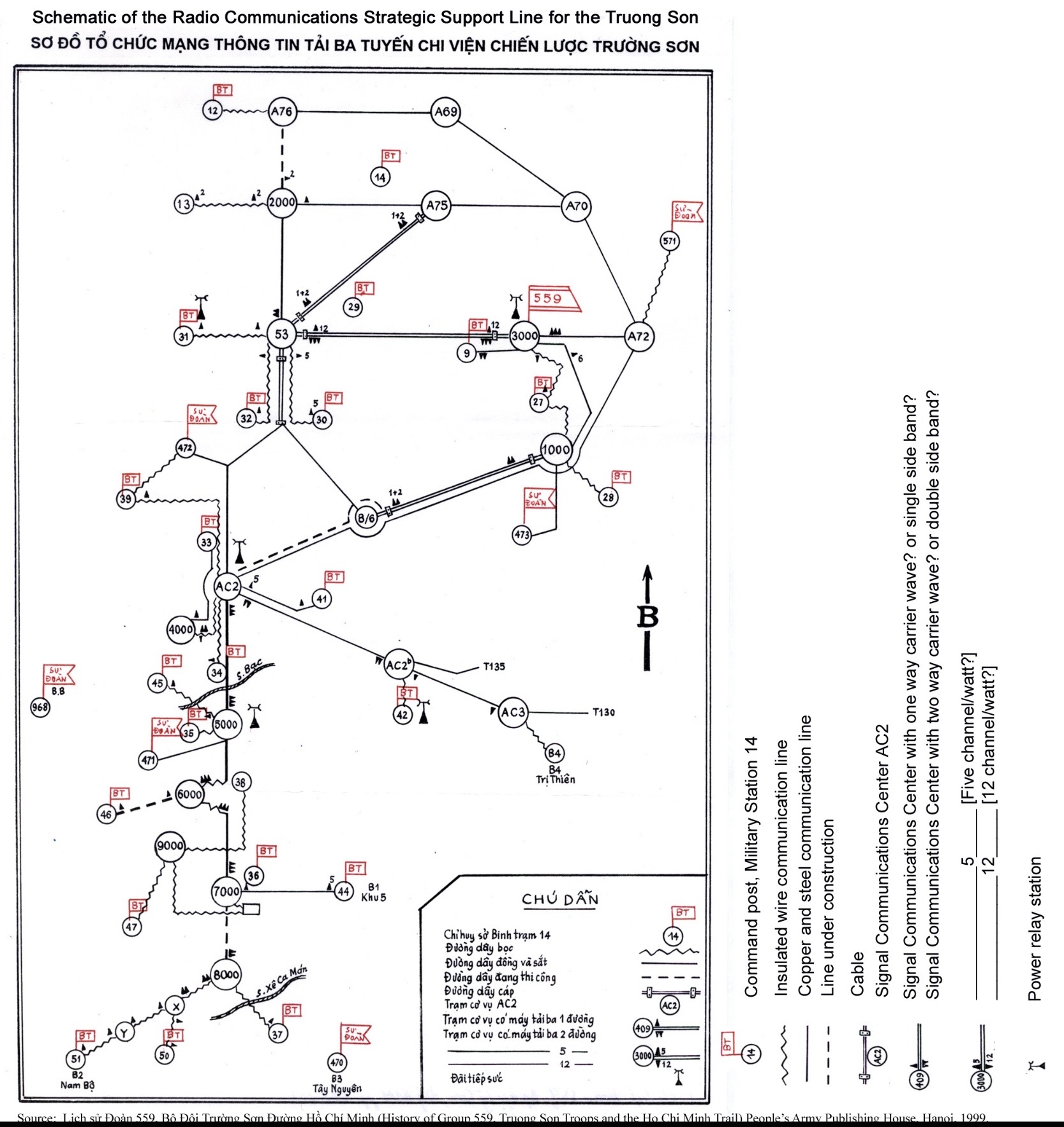
The Ky Son switchboard was a wired telephone exchange in the Binh Tram 35 network operated by BTL 471. It relayed traffic northward through the PAVN bare-wire / overhead carrier-wave communications system (dây trần / dây tải ba) to higher headquarters, which routinely retransmitted through Vinh-area antennas for command purposes. This is the “Vinh Window” collection dynamic documented by Robert J. Hanyok (2002, pp. 110–113). Southern Laos transmissions (including Binh Tram 35 nets) appeared to originate from Vinh due to PAVN relay mechanics, while content and unit designators remained tied to the Trail corridor.
A USAF Security Squadron RC-135M Combat Apple veteran and Vietnamese linguist (1972–73) corroborated: “Communications relayed from Laos via bare-wire and radio systems ‘would appear to originate from Vinh antennas,’ with the platform focusing on content rather than precise emitter locations due to limited direction-finding capabilities of the RC-135M Combat Apple at the time.”
The same wired network that carried the 1970 “Ky Son switchboard” visual confirmation of the AC-130 crash also carried the 1973 prisoner-movement traffic from Km 44. The apparent “Vinh origin” is therefore a relay artifact, not evidence of a northern Laos or Vinh-based incident. (Sources: Nguyen Hoang BTL 471 memoir, 2015; BTL 471 command-post operational accounts; 1999 Lịch sử Đoàn 559 schematic.)
5. Direct Rebuttal to the DeStatte (1996) and Bentz (2016) Interpretations
DeStatte’s July 1996 memos (and the 2016 DPAA review led by Guy Bentz) asserted that the “four pirates” referred to Lao irregulars (“phi” / bandits) captured during unrelated mopping-up operations near Vinh or Route 8/7. This interpretation fails on four grounds:
- Terminology Precedent: The generic PAVN term “pirate pilots” / “pilots” / “pirates” was used consistently across multiple Trail units in 1970–1972 for confirmed U.S. aircrew.
- Unit Continuity: Group 210 (210th AAA Regiment) operated under the 377th Air Defense Division / 471st Command in the southern Laos corridor — the same operational environment reflected in the 1970–1972 reports.
- Geography: The Km 44–93 movement corridor lies inside Binh Tram 35’s documented AOR on Route 128 (JTF-FA Investigation Report on Case 1437, 2002; PAVN maps and veteran accounts). This is further confirmed by the 1970 gasoline-convoy fire at Km 48 / Tang Cat, where Political Commissar Nguyen Tuan was killed while attempting to extinguish a burning fuel truck (PAVN article “Quên mình cứu đoàn xe chở xăng,” sknc.qdnd.vn/ky-niem-sau-sac/quen-minh-cuu-doan-xe-cho-xang-503067). The proximity of Km 44–48 places the Baron 52 movement directly inside active BT35 territory during the exact period of the intercepts.
- Communications Mechanics: The Vinh Window relay explains the collection header without relocating the source.
Lao irregulars were handled by Pathet Lao channels and routed to re-education camps; they were never moved under PAVN Group 210 along Route 128 by Mr. Van (the documented southern Laos POW handler).
6. Conclusion and Implications
The consistent use of “pirate pilots” / “pilots” / “pirates” terminology across multiple 1970–1972 shootdown reports in the NSA Correlation Studies provides contemporaneous, primary-source evidence that this was standard PAVN slang for U.S. airmen operating in the southern Laos Trail corridor. When the identical network produced the 1973 Baron 52 intercepts reporting four captives moved from Km 44, the meaning was unambiguous. The Vinh Window relay and Ky Son switchboard explain the collection mechanics without altering the source or unit. This directly refutes the DeStatte/Bentz “Lao irregulars” hypothesis and supports the conclusion that the four back-end Baron 52 crew members survived the crash, were captured, and were moved alive through the Binh Tram 35 logistics network.
Further declassification of full Baron 52 SIGINT multichannel transcripts and targeted outreach to Binh Tram veterans via VNOSMP are recommended.
References
- NSA TOP SECRET UMBRA POW/MIA Correlation Study, REFNO 1600, document 4141419, page 53 (declassified).
- NSA Multichannel Intercepts 2/R0/182-73 and 2/R0/186-73 (Baron 52, 5 Feb 1973; 2008 retranslation).
- NSA Correlation Studies (1992, 1993, 1996) linking REFNO 1983 to February 5 intercepts.
- Hanyok, Robert J. The Vinh Window Collection (2002), pp. 110–113.
- JTF-FA Investigation Report on Case 1437 (Tang Cat / Binh Tram 35, 2002).
- Nguyen Hoang, “Early dry season 1972 in Southern Laos” (Truong Son Veterans Association, 12 Sep 2015).
- BTL 471 command-post operational accounts and 1999 Lịch sử Đoàn 559 schematic.
- “Quên mình cứu đoàn xe chở xăng” (PAVN article on Political Commissar Nguyen Tuan’s death at Km 48 / Tang Cat), sknc.qdnd.vn/ky-niem-sau-sac/quen-minh-cuu-doan-xe-cho-xang-503067.
- DeStatte, Robert J. DIA memos (17 & 19 July 1996).
- Bentz, Guy. DPAA Review of REFNO 1983 (2016).
- USAF Security Squadron RC-135M Combat Apple veteran statement (1972–73 Vietnamese linguist / SIGINT operator).
- Stories of Sacrifice research posts (27 Sep 2025 & 19 Nov 2025).
This paper is based solely on declassified primary sources and researcher-provided documentation. All interpretations are the author’s and offered for further official review.

Investigative Researcher & Host of Stories of Sacrifice Podcast
John Bear is an accomplished investigator and forensic genealogist with over 20 years of experience specializing in World War II, Korea, and Vietnam War POW/MIA cases. He has honed forensic-level skills in open-source intelligence (OSINT) and archival research, bolstered by coursework in Advanced Research Methods and Databases for Historians. Inspired by the loss of his uncle, a WWII POW/MIA identified posthumously in the Philippines, John volunteers directly with families of the missing to provide answers and closure. As a key member of the Asymmetric MIA Accounting Group (AMAG), he works directly with MIA families to support projects alongside Military Service Casualty Officers, DPAA Historians, and military intelligence experts. Through his contributions to the Cabanatuan POW Camp, Philippine Hellship Project, and Bataan Death March, John’s efforts have led to over 350 potential WWII identifications through Family Reference Sample (FRS) DNA collection. His investigation into the Vietnam War’s Baron 52 incident uncovered compelling OSINT-based evidence suggesting crew survival, and his work on WWII unrecovered MIAs on Mindanao has generated critical leads. Through his podcast, Stories of Sacrifice: American POW/MIAs, John amplifies families’ stories, ensuring the legacies of the missing are honored.
Baron 52 Docu series Podcast Link: https://www.storiesofsacrifice.org/category/baron-52/
Baron 52: New Vietnamese Sources and the Case for Technical Review