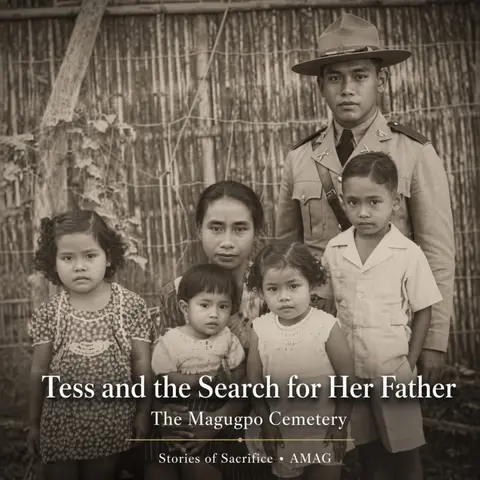
The Absence That Never Ended
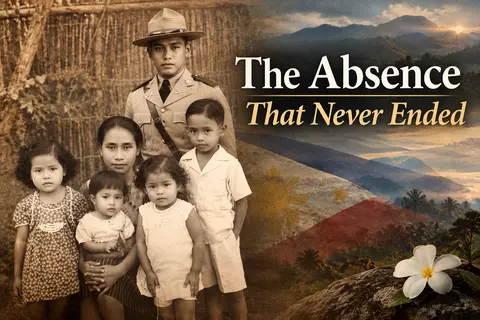
After more than eighty years, Teresita G. Bernales is still searching for the father she never knew.
By John Bear
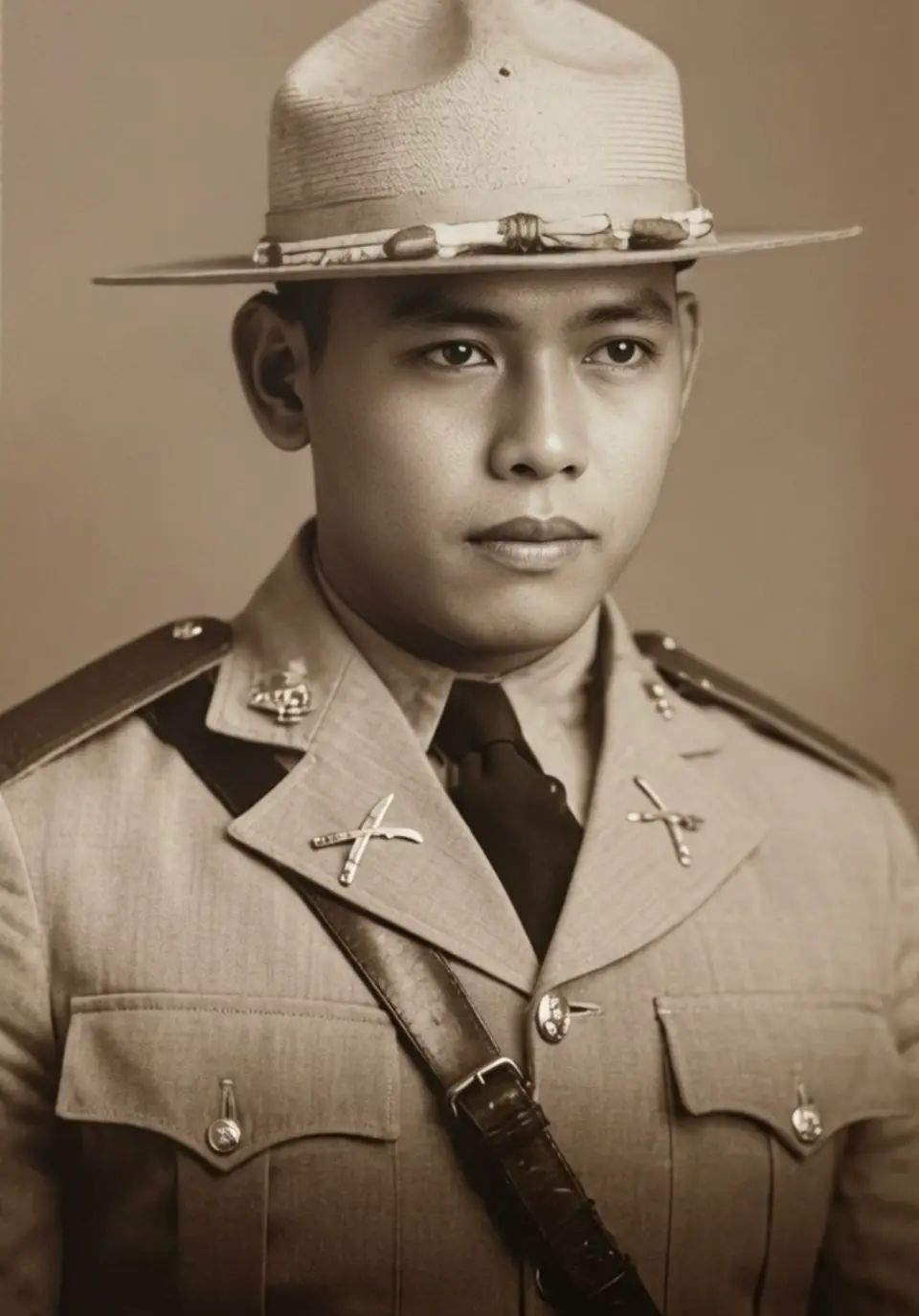
Caption: Captain Francisco Maniquiz Gregorio, Philippine Constabulary. Executed in Magugpo, 10 July 1942. His remains have never been recovered. Photo courtesy of Teresita G. Bernales
“I was only a baby when he went back to Davao. He was there when I was born, but I have no memory of him. At my age, I still want to know where he is.”¹
For Teresita G. Bernales, her father is both a family memory and a question that has remained unanswered for more than eighty years. Captain Francisco Maniquiz Gregorio held his newborn daughter in his arms in 1939. He had returned home from his Philippine Constabulary assignment in Davao, spent a few weeks with his family, and then went back to his duties. He would never return.
On July 10, 1942, Japanese forces executed Gregorio and seven other men at Magugpo, in what is now Tagum City, Davao del Norte. SCAP War Crimes Branch Report No. 186 documents the execution of one American civilian and seven identified Filipino citizens. Among those named in the historical records were Colonel Felicisimo Torres, Lieutenant Amado V. Halili, Lieutenant Alejo S. Ong, Lieutenant Francisco Roa, and American civilian Robert James Zacks. Postwar investigators documented the execution and recorded evidence concerning the men who died there. Their remains were never recovered, and the precise burial location has yet to be established.²
In 2026, Teresita reached out to Asymmetric MIA Accounting Group (AMAG), an independent research organization working to account for unrecovered American and Philippine personnel from past conflicts. Her hope was that the historical record might finally lead to the place where her father rests.
The man behind the absence
Before he became one of the men whose fate was recorded in a wartime investigation, Francisco Gregorio was a teacher, a husband, and a father.
He graduated from the University of the Philippines in 1930 with a degree in education and a major in mathematics. He taught briefly at Nueva Ecija High School, where he also coached basketball. But a teacher’s salary was not enough to support the family he hoped to build. According to family accounts, he explained his decision to pursue a military career simply: “I cannot support my family on a teacher’s salary.”¹
He applied to the Reserve Officers’ Service School, the predecessor of the Philippine Military Academy, and was accepted. His assignments took him to Pangasinan, Tarlac, Nueva Ecija, and eventually Davao, where he trained soldiers. By the outbreak of war, he was serving with the 1st Davao Company under Major Gregorio Ferreol.
Gregorio had met Mercedes while teaching in Nueva Ecija. She was a popular student known for her singing and had taken opera lessons in high school. After she graduated, Gregorio and members of his family traveled to Laur, Nueva Ecija, to ask her father for permission to marry. Her father, the town’s Municipal President, refused. He wanted his eldest daughter to continue her education.
The couple eloped.
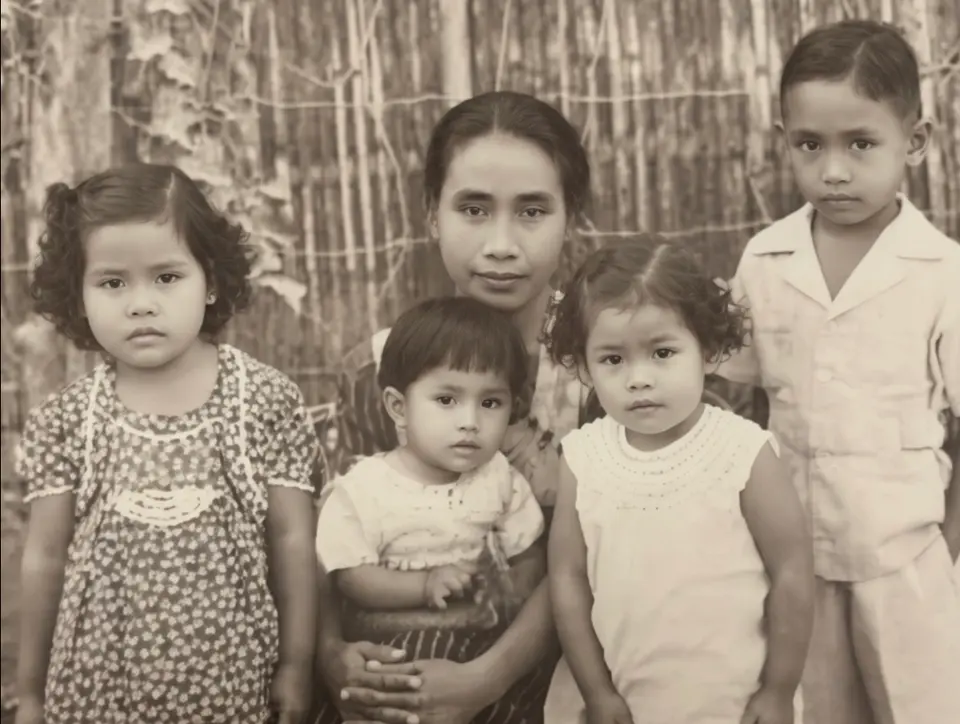
Caption: Left to right: Rosita, Mercedes (mother), Evangelina, Francisco. Front: Teresita on her mother’s lap. Circa 1941. A family still waiting for answers. Photo courtesy of Teresita G. Bernales.
They raised four children: Rosita, Evangelina, Francisco Jr., and Teresita. Their lives would be shaped by a war that separated the family from its father and left them without a known grave to visit.
The internment that set events in motion
In the days after the Japanese attack on December 8, 1941, Philippine Constabulary and Army units in Davao were ordered to round up and intern Japanese civilians living in the province. Davao had a large Japanese community—businessmen, plantation workers, shopkeepers, and families who had settled there over decades. With limited manpower, the Constabulary concentrated the internees into fewer camps in the center of Davao City.
Schools, cockpits, and other public buildings became holding sites. Thousands of Japanese men, women, and children were moved under guard. Conditions were crowded. Food was scarce. The Constabulary faced the practical problem of guarding a large civilian population while Japanese forces advanced.³
After the Japanese occupied Mindanao in 1942, they arrested many of the officers who had carried out those internment orders. The charges were mistreatment of Japanese civilians. Captain Gregorio was among those arrested.
Arrested in a war that had already changed
Captain Gregorio was captured near Malaybalay on May 10, 1942. He was transferred under guard and arrived at the Davao concentration camp in early July.
Lieutenant Colonel Gregorio F. Ferreol later described the selection process in his affidavit of 14 January 1946:
“On June 24, 1942, all military prisoners of war including myself were lined up for a supposedly inspection. … From the complete group of prisoners of war, these three Japanese picked out about 37 officers and men. … Among those who were picked out and segregated were Lieutenant Colonel Felicisimo Torres, Lieutenant Alejo S. Ong, Lieutenant Halili (MC), … and myself. … On the morning of 25 June, 1942, we were taken to Cagayan by truck. I noticed for the first time that Lieutenant Zacks was placed on the same truck.”²
On July 10, the selected group was taken by truck to Magugpo. The prisoners were reportedly forced to dig their own graves before being executed. A civilian witness provided an account of the deaths, and the men were buried together.
The war crimes investigation
The principal U.S. archival record is SCAP War Crimes Branch Report No. 186, Case P-92. Preserved in the National Archives, the file includes a review memorandum dated February 1, 1946, and affidavits from witnesses and others familiar with the events.²
In her 8 October 1945 interview, Madeleine Zacks stated:
“Informant advised that her husband, Robert James Zacks, had served as a civilian aide to Colonel R. Hillsman at Davao for a period of approximately two weeks from December 9 to December 20, 1941. On December 20, 1941 at the time of the Japanese entry into Davao, he fled from there to his family, in Malaybalay, Bukidnon, Mindanao.”²
She continued:
“On 23 June 1942 he was taken from his family by Japanese military authorities and was never seen again. Informant stated that a Dr. Gross … told her that a Japanese … told him that Zacks had been executed along with 9 other men at a place near Santa Ana, Davao on 10 July 1942. … At Davao a military trial was said to have taken place after which Informant’s husband and 9 other men, including Colonel Torres … and a Dr. Hallili … were executed.”²
Leslie E. Stevens testified under oath on 2 January 1946 about Zacks’s work under Colonel Hillsman:
“A report reached Colonel Hillsman that there were firearms in the office of the Ohta Development Company at Talomo. I was instructed by Colonel HILLSMAN, together with Mr. ZACKS, to proceed there to blow the vault open if necessary and find out what was in there. Mr. ZACKS and I, accompanied by Mr. Hugh WELLS who was serving under me as demolition officer, proceeded to Talomo and blew open the vault and found business papers and a sum of money which, if I recall correctly, was around P 1,700.00. This money was brought to American Headquarters in Davao and Colonel HILLSMAN instructed Mr. ZACKS to turn it in to the City Treasurer, Mr. DAVID, and obtain a receipt which Mr. ZACKS did, and the receipt was turned over to Colonel HILLSMAN.”²
Ferreol confirmed the same episode in his supplementary statement of 24 January 1946:
“I wish to state that Lt. Zack, with other officers whom I do not remember now, was directed by Colonel Hilsman to open the safe of the Ohta Development Company in order to investigate whether there are fire-arms, explosives and secret documents which would affect the war between the Allies. Upon opening the safe some money aside from various papers were found in the safe. Same were brought to the headquarters of Colonel Hilsman by Lt. Zack. The money was turned over to the Acting Provincial Treasurer who issued an official receipt for the same. This I know of my own knowledge.”²
Civilian witness Socorro Lopez described the execution at Magugpo. She stated that she hid near the site and watched as Japanese soldiers dug a long common grave. The prisoners were forced to dig their own graves, and the executions were carried out by beheading. The bodies were buried together.²
The postwar review addressed the circumstances of the execution and the Japanese tribunal associated with the case. It described the charges as apparently fabricated and the witnesses as prejudiced, while recording that proceedings had taken place under the Japanese occupation authorities. The case was closed.²
The record is significant because it documents the execution and preserves testimony about what happened. But a historical record of an execution is not the same as a recovered grave. The documents have not, by themselves, established the precise location of the burial or provided the family with identified remains.
For Teresita, those distinctions have practical consequences. Her father’s fate is documented in the historical record, yet she still has no confirmed resting place to visit.
A childhood shaped by war
Teresita grew up with the consequences of her father’s absence, though she was too young to understand the circumstances of his death.
The family lived with her maternal grandparents in Laur. As the Japanese occupation spread, they evacuated to Siclong, a remote barrio on one of her grandfather’s farmlands in the Sierra Madre. Her older brother, Francisco Jr., later remembered the area as isolated but well supplied, with a pond for fishing, fruit trees, and farmers who brought food to the family.¹
After the surrender of organized Filipino and American resistance, the family returned to town and lived under Japanese rule. School resumed, with Japanese language instruction included in the curriculum.
Later, as fighting returned to the area, the family fled again. Teresita remembers eating lunch when gunfire broke out and someone shouted that Japanese soldiers were shooting people and looting. “We ran as fast as we could,” she recalled.¹
Her brother urged their mother not to leave the youngest child behind. “Mother, carry Tessie or she will be left behind.”¹
The family retreated to a prepared refuge behind the hills of Canantong, another of her grandfather’s plantations. After the danger passed, they returned home and began rebuilding.
These memories offer a glimpse of the insecurity that shaped Teresita’s earliest years. Her father was absent, the country was at war, and the family’s survival depended on the protection and resourcefulness of those around them. The childhood she remembers was one in which safety could never be taken for granted. What remains clear in her recollections is the fear of displacement and the role her mother and siblings played in keeping the family together.
The life she built
Teresita’s life eventually took her far from Laur and the circumstances of her childhood.
After college, she decided to pursue graduate studies in the United States. Her older sister, a physician, was already in New York City for her residency. A relative, Beatriz Maniquiz, had recently returned from graduate study at Syracuse University and recommended the experience. Beatriz’s father was a first cousin of Teresita’s father.¹
Teresita went to Syracuse, where she earned an Ed.D. in Counseling Psychology. She worked as a school counselor in the Syracuse City School District and became Executive Director of the International Center of Syracuse. In 2000 she moved to Hawaii, where she accepted the position of International Visitor Leadership Director at the Pacific and Asian Affairs Council. After that she worked at the State Department’s International Visitor Leadership Program as a Language Consultant.⁴
In Hawaii she has also been active in the Consular Corps and Filipino community organizations. She built a professional life that crossed borders and connected people from different countries and cultures.
Yet the question of her father remained.
Teresita had never known the sound of his voice or formed memories of his face. She had the accounts preserved by her mother and siblings, the archival record of his execution, and the knowledge that the remains of the men killed with him had never been recovered.
Over the years, she sought answers through official channels. According to the family’s account, those efforts did not lead to a recovery effort. The men’s absence from the government accounting process, as described by Teresita and AMAG, became another reason to seek an independent path forward. The precise scope of that status is a matter for the records to establish, but the family’s need was straightforward: to find out where her father rests.¹
From a closed file to an active search
In 2026, Teresita contacted AMAG and asked whether the organization would investigate her father’s case and attempt to recover him.
AMAG conducts independent archival research, site investigations, and recovery operations involving unrecovered American and Philippine personnel from World War II and other conflicts. It works with families, local partners, agencies, and national authorities, including in coordination with U.S. agencies. It does not represent the U.S. government. Its motto is “It’s About Time.”⁵
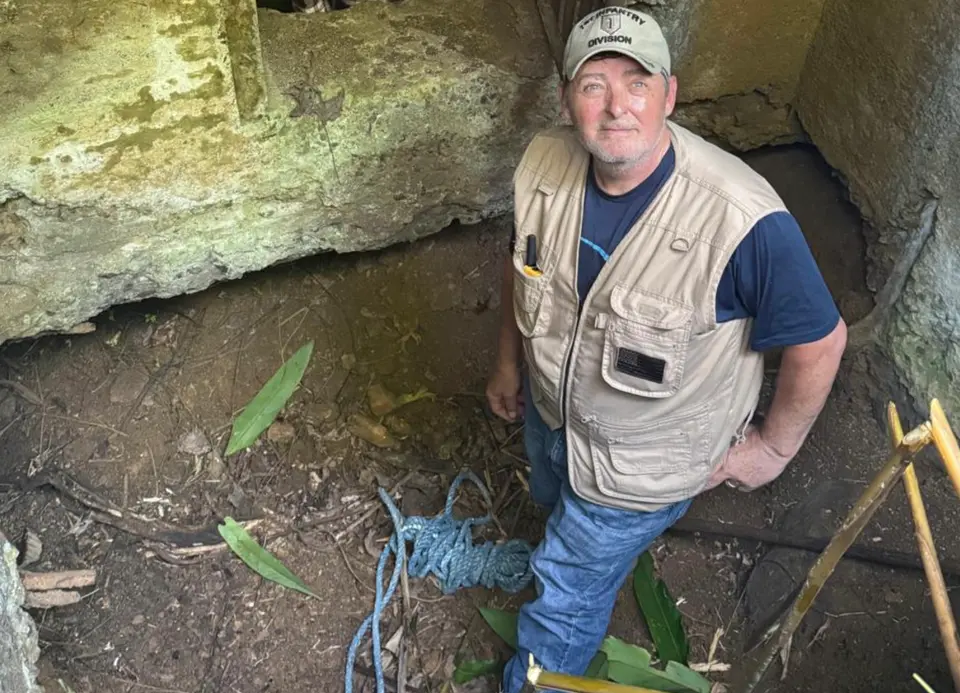
Caption: Mike Henshaw, founder and director of Asymmetric MIA Accounting Group (AMAG), at a site in Lanao del Sur associated with the loss of unrecovered American servicemen, 2026. AMAG is a Virginia-based 501(c)(3) nonprofit working to account for missing U.S. personnel.
For this case, AMAG has assembled the SCAP Report 186 file, postwar affidavits, newspaper accounts, and related records. A family-authorized local coordinator is assisting in the Davao region.⁵
“When you can put a name back with a family after all these years, it changes everything for them,” said Mike Henshaw, AMAG’s Founder and President. “It’s not just about the remains. It’s about giving a daughter the chance to finally say goodbye to the father she never knew.”⁵
The first challenge is to establish the burial location with sufficient confidence to justify a recovery operation. Historical references to Magugpo provide a starting point, but the precise location must be investigated on the ground. Site access, permissions, and the conditions encountered during fieldwork will determine what can be done next.
AMAG has planned a site investigation in the Tagum–Magugpo area for November 2026. If the evidence supports a recovery operation and the necessary permissions are obtained, the organization is targeting early 2027.
If remains are recovered, they would require careful forensic examination. DNA reference samples from family members could assist with identification, depending on the condition of any recovered material and the availability of suitable comparative evidence. Neither recovery nor identification is guaranteed.
These qualifications are important. The aim is not simply to reopen an old file or repeat what investigators recorded in 1946. It is to determine whether the surviving evidence can guide a responsible effort to locate the burial and, if possible, account for the individuals who were executed there.
The historical record documents the execution date, the Magugpo location, the transfer of prisoners to the site, and the fact that their remains were never recovered. The investigation now has to move from those records to the ground.
For Teresita, the effort represents a possibility she has waited decades to pursue: that the place where her father was buried might finally be found.
The answer a daughter is still seeking
More than eighty years after Captain Francisco Maniquiz Gregorio was executed at Magugpo, the historical record preserves the circumstances of his death. What it has not provided his family is a confirmed grave—a place where his daughter can stand, remember him, and leave flowers.
Teresita was too young to remember the father who held her as a newborn. She has lived a full life without knowing where he rests. Now, while she is still here to see the effort unfold, researchers are attempting to turn the surviving evidence into a location and, if the evidence permits, a recovery.
The outcome is not yet known. The site must be investigated, any recovery must be conducted carefully, and any remains must be examined before an identification can be established.
But the question that has followed Teresita throughout her life is no longer confined to an old file.
“At my age,” she has said, “I still want to know where he is.”¹
For a daughter who never had the chance to know her father, that answer is still worth seeking.
AMAG’s work on this case and others is supported by private donations. Contributions help fund archival research, site investigations, and recovery efforts for unrecovered personnel whose families are still waiting. To support this mission, visit https://donorbox.org/support-amag-s-worldwide-mia-mission
Sources
- Family statements and authorizations supplied by Teresita G. Bernales to Asymmetric MIA Accounting Group (AMAG), 2026. Includes personal recollections of wartime evacuations, her father’s career decision, and her education and professional path.
- National Archives and Records Administration (NARA), Record Group 331, Records of Allied Operational and Occupation Headquarters, World War II. War Crimes Branch Report No. 186 (Case P-92), “Execution of One American and Seven Identified Filipino Citizens at Magugpo, Mindanao, P.I., 10 July 1942.” Includes the 1 February 1946 review memorandum; affidavits of Lt. Col. Gregorio F. Ferreol (14 and 24 January 1946); sworn statement of Leslie E. Stevens (2 January 1946); interview memorandum of Madeleine Zacks (8 October 1945); and affidavit of civilian witness Socorro Lopez.
- Barriga, Maria Cynthia B. The “Japanese” Locals of Davao and of Guam: Shifting Belongings amidst Successive Empires during and after the Pacific War. PhD dissertation, Graduate School of Asia-Pacific Studies, Waseda University, 2020. Contextual material on Japanese civilian internment in Davao, December 1941.
- Consular Corps of Hawai‘i biographical listing for Teresita G. Bernales; LinkedIn profile information for Teresita Bernales (public).
- Asymmetric MIA Accounting Group (AMAG) case files on Captain Francisco Maniquiz Gregorio, including site investigation planning documents, family authorization letter, and “Case for Inclusion: Robert James Zacks” (prepared by John Bear, AMAG, 2026). AMAG website, leadership and mission pages (amagonline.org).
- U.S. Department of Labor, Immigration Service Form 960, List or Manifest of Aliens Employed on the Vessel as Members of Crew, SS Point Ancha, arrival Houston, Texas, 5 April 1933 (entry for Zacks, Robert).
- “Boy Reveals Father’s Death,” Los Angeles Examiner (Los Angeles, California), Friday, 4 May 1945, p. 13.
- DoD Directive 2310.07, “Past Conflict Personnel Accounting Policy,” 12 April 2017 (Change 2 effective 18 August 2026).
Subject Information:
Teresita G. Bernales
Teresita G. Bernales is the daughter of Captain Francisco Maniquiz Gregorio. She is a psychologist and consultant with the U.S. Department of State.
Mike Henshaw
Mike Henshaw is Founder and President of the Asymmetric MIA Accounting Group (AMAG). A combat veteran and former U.S. Army Mortuary Affairs specialist, he has led investigative and recovery missions for missing service members from World War II to current conflicts. Contact: mike@amagonline.org
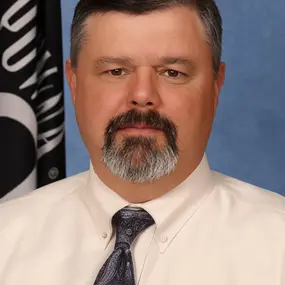
Investigative Researcher & Host of Stories of Sacrifice Podcast
John Bear serves as Chief of Investigative Research for the Asymmetric MIA Accounting Group (AMAG) and as Founder of US POW/MIA Family Locating. He is also host of the Stories of Sacrifice: American POW/MIAs podcast and author of its accompanying research blog. A forensic genealogist and investigative researcher with more than twenty years of experience, he specializes in open-source intelligence, archival research, and DNA-based identification methods applied to POW/MIA cases from World War II, the Korean War, and the Vietnam War.
His current research focuses on primary-source case development for unresolved Philippine losses, with particular attention to the 1942 Camp Keithley executions and the case of Brigadier General Guy O. Fort, as well as the Vietnam War’s Baron 52 incident. This work integrates archival records, signals intelligence intercepts, extensive witness interviews, and collaboration with local historians, intelligence experts, and institutional partners. A substantial portion of the resulting case files has advanced matters currently under review by Department of War agencies.
Research on the Bataan Death March has contributed to the first DPAA Bataan Death March disinterments and has supported Family Reference Sample DNA collection for more than 200 missing persons along the route. Earlier work on the Cabanatuan POW Camp and the Philippine Hellship Project, in conjunction with the Bataan research, has supported more than 450 potential World War II identifications through Family Reference Sample DNA collection.
Through peer-level research outp… Read More
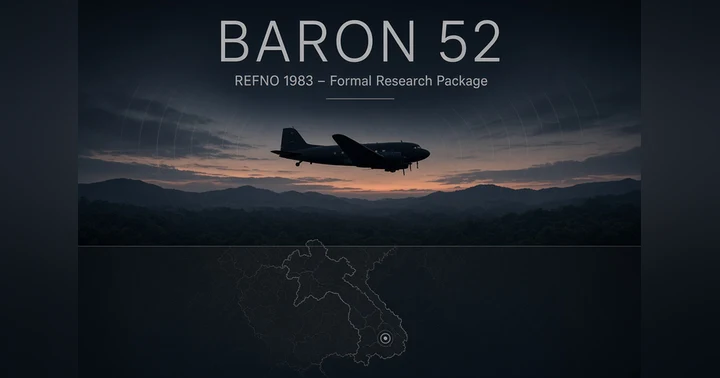
Baron 52: New Vietnamese Sources and the Case for Technical Review