
It’s About Time: The Forgotten Men and the Families Still Waiting
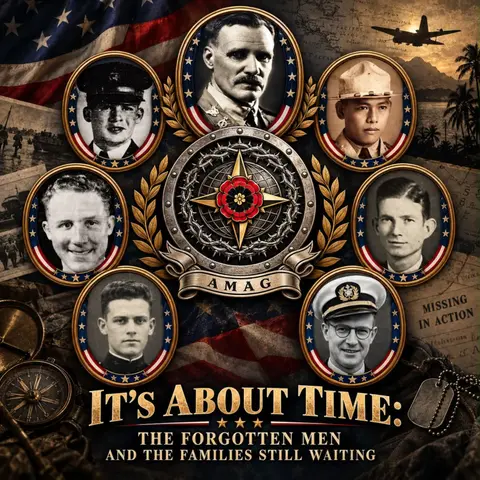

Eighty-four years after they were executed or died on Mindanao, these men are still missing—and their families are still waiting. Tess Bernales was an infant when her father was taken. Henry Zacks was the boy who forgot how to smile. Helen Welbon never saw her husband’s grave. The Fort family has never had a place to stand.
AMAG’s all-volunteer team has identified the sites, partnered with Filipino archaeologists, and is preparing to return from late November 2026 through March 2027. Leadership and scientists have funded most of the work from their own resources. Both the United States and the Philippines should help finish it. Private support is still essential.
Donate here:
https://donorbox.org/support-amag-s-worldwide-mia-mission
Eighty-four years is long enough.
It’s About Time.

 Apple Podcasts
 Spotify
 Amazon Music
 Overcast
 Castro
 iHeartRadio
 PocketCasts
 Castbox
 Podchaser
 TuneIn
 Deezer
 Spreaker
 Pandora
 RSS Feed
 YouTube
 Stories of Sacrifice / AMAG Mindanao Mission
Eighty-four years after American and Filipino personnel were executed or died on Mindanao, their families are still waiting for graves. This episode tells the stories of the forgotten men and the daughters, sons, and widows who have carried the absence ever since—and why funding is needed now to complete the search.
The Families
- Tess Bernales — An infant when her father, Capt. Francisco Maniquiz Gregorio, was executed on 10 July 1942 at Magugpo Cemetery (now Tagum City). She is now in her mid-eighties and has authorized AMAG to represent the family. A site investigation is planned for November 2026, with recovery targeted for early 2027 so she can still be part of it.
- Henry Zacks and Madeline Zacks — Henry was ten years old in 1945 when newspapers called him “the boy who had forgotten how to smile.” His father, American civilian Robert James Zacks, was buried in the same Magugpo common grave. His mother carried the news through internment.
- The Fort Family — Brig. Gen. Guy O. Fort was executed in November 1942 after refusing to order Moro guerrillas to surrender. His family has never had a grave. Barbara Fox and Dr. Joseph Postigo (brother of the late actress Julie Vega, Fort’s great-granddaughter) are working directly with AMAG. An independent panel’s first assessments fell within 15–75 meters of the research target.
- Helen and Roy Welbon — Helen left on the USS Narwhal in November 1943 at her husband’s insistence. On 26 February 1944 Col. Wendell Fertig reported that 1st Lt. Roy E. Welbon had been killed on 24 January while evacuating radio equipment at Baroy and buried in a marked grave with full military honors. She never saw the place. The family is now working directly with AMAG.
- Pratt, Vesey, Price, and Chandler — 1st Lt. Robert H. Pratt died supporting an older officer on the July 1942 march into Iligan. Lt. Col. Robert H. Vesey volunteered to take the place first assigned to Fort and endured roughly two hours under the bayonet. Living eyewitness Ben Hagans has described the ground. These families have lived with closed files that pre-dated the evidence now in hand.
Many of the men buried with the Americans were Philippine Army, Constabulary, and Scout personnel. The same investigations serve their families too.
Why This Mission, Why Now
Years of primary-source research led by Chief of Investigative Research John Bear identified the sites. Imagery analyst Ed Bauer’s review of period aerial photography and archival records further narrowed the candidate areas. AMAG’s all-volunteer team—Founder and President Michael Henshaw, John Bear, forensic anthropologist Karin Dominko, conflict archaeologist Danny Keay, and Ed Bauer—has partnered with Filipino archaeologists and the Bangsamoro Commission for the Preservation of Cultural Heritage. Mindanao is a red zone for U.S. government travel, which has kept large official teams away. Leadership and scientific volunteers have funded most of the work to date from personal resources.
The late-November 2026 through March 2027 window will advance the Fort locus, investigate the Magugpo site, and continue work on the Welbon and Pratt leads. Every investigation is designed to end with a recoverability recommendation or a documented closure. Recoveries will follow chain-of-custody through the National Museum of the Philippines.
Support the Mission
Both the United States and the Philippines should help fund completion of this work. Private donations are still essential.
Donate here:
https://donorbox.org/support-amag-s-worldwide-mia-mission
Every contribution supports travel, local coordination, equipment, training of Filipino archaeologists, and the ability of volunteers to stay in the field.
Eighty-four years is long enough.
It’s About Time.
