
Baron 52: New Vietnamese Sources and the Case for Technical Review
John Bear
Chief of Investigative Research
Asymmetric MIA Accounting Group (AMAG) Inc.
18 August 2026
Executive Summary
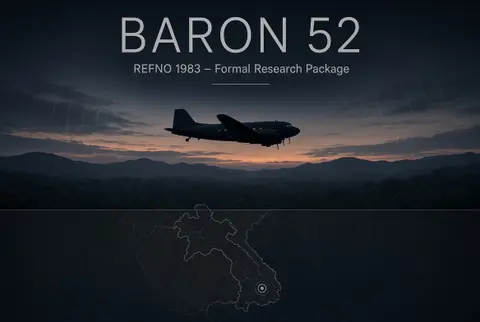
On 5 February 1973 a U.S. Air Force EC-47Q aircraft, call sign Baron 52, was shot down over southern Laos while conducting a signals-intelligence mission. The eight-man crew was declared killed in action and the case was later carried as resolved, with a group interment at Arlington National Cemetery in 1996. A 2016 review upheld that determination.
In August 2026 a formal research package was submitted to the Department of War requesting a limited technical and policy review. The package does not claim that survival or long-term captivity of any crew member has been conclusively proven. It presents three categories of material that were unavailable, or not fully examined, during earlier reviews:
- Physical and forensic indicators from the limited 1993 excavation that raise questions about the assumption that all four back-end crew members perished at the crash site.
- Declassified signals-intelligence reporting (REFNO 1983) in which the final NSA retranslation, produced from the recorded audio, footnoted that “pirates” was “usually a coverterm for American pilots.”
- Primary Vietnamese sources identified in 2025–2026 that place the 210th Anti-Aircraft Regiment under Division 471 and locate Division and Binh Tram 35 elements in the Tang Cat / Route 128 sector (approximately Km 44–48 and the low-90s) during the exact period of the intercept.
The package argues that these materials, taken together, raise sufficient unresolved questions to justify independent re-examination. It further notes that no Baron 52-specific oral-history interviews have ever been conducted with veterans of the relevant units, and that those individuals are now elderly. The recommendation is therefore narrow: that the Department of War assess whether the new correlative evidence warrants a limited technical review so that remaining witnesses may still be interviewed while they are living.
Introduction
On the night of 4–5 February 1973, nine days after the signing of the Paris Peace Accords, a U.S. Air Force EC-47Q electronic reconnaissance aircraft flying under the call sign Baron 52 was shot down over southern Laos. The aircraft, assigned to the 361st Tactical Electronic Warfare Squadron with a back-end crew from Detachment 3 of the 6994th Security Squadron, was conducting a nighttime signals-intelligence collection mission along the Ho Chi Minh Trail. The eight-man crew consisted of four flight-deck personnel and four electronic-warfare specialists. The aircraft crashed in Saravane Province. Official U.S. accounting ultimately determined that all eight crew members were killed in action. The case was carried as resolved, and a group interment was conducted at Arlington National Cemetery in March 1996.
In August 2026 the Asymmetric MIA Accounting Group submitted a formal research package to the Department of War and to multiple congressional offices. The package requests a limited technical and policy review of the Baron 52 incident. It does not assert that the survival or long-term captivity of any crew member has been conclusively proven. Rather, it argues that newly available primary Vietnamese sources, refined analysis of declassified signals intelligence, and documented limitations in the scope of earlier investigations raise sufficient unresolved questions to warrant independent re-examination—particularly while remaining Vietnamese veterans of the relevant units and sector are still living.
This article summarizes the principal findings of that package, the evidentiary framework on which it rests, and the narrow recommendation it advances.
Historical Background and Official Determinations
Baron 52 departed Ubon Royal Thai Air Force Base late on the evening of 4 February 1973 on what was known as a “Midnight Smoker” mission. The aircraft was configured for airborne radio direction finding and related signals-intelligence collection against People’s Army of Vietnam (PAVN) communications along the logistics corridors of southern Laos. At approximately 0140 hours on 5 February the crew reported receiving heavy anti-aircraft fire. Radio contact was lost shortly thereafter. The aircraft crashed on a jungled mountainside in Saravane Province.
Search-and-rescue efforts located the wreckage on 7 February. A limited ground inspection by a Jolly Green helicopter team on 9 February confirmed the site but was constrained by enemy presence and time on the ground. The Air Force declared the entire crew killed in action on 22 February 1973.
In November 1992 a survey team revisited the site. A joint U.S.–Lao excavation conducted in January–February 1993 recovered limited skeletal fragments, a tooth, personal effects (including a dog tag associated with Sgt. Joseph A. Matejov), lap-belt hardware, parachute components, and two revolvers found at a distance uphill from the fuselage. These materials formed the basis for the subsequent “accounted for” determination. A group burial of the remains associated with the crew was held at Arlington National Cemetery on 27 March 1996.
In 2016, following sustained family advocacy, the Air Force and the Defense POW/MIA Accounting Agency conducted a review of the case. That review upheld the existing determination. As of 2026 the agency continues to list the case as resolved and has stated in official correspondence that it is not permitted to expend resources on reevaluation.
The 2026 Research Package: Structure and Scope
The formal submission package consists of eleven principal documents:
- Cover memorandum to Under Secretary of War Anthony J. Tata
- “What We Are NOT Claiming” scoping statement
- Executive Summary (July 2026)
- Congressional Briefing Document
- Full research report (Reassessment of the Baron 52 Incident)
- Intercept Addendum – Expanded Analysis of the REFNO 1983 Intercept
- Summary of deficiencies in the 2016 review
- Detailed rebuttal to the 2016 analysis
- Compilation of primary Vietnamese sources
- U.S. Intelligence Community Reporting and Correlations Addendum
- Vinh Window Open-Source Intelligence Research Report
The package is deliberately bounded. The scoping document states that the submission does not claim that survival or capture of the four back-end crew members has been conclusively proven, that prior official assessments were conducted in bad faith, or that any specific individual has been definitively identified beyond the available documentary correlations. These matters remain open questions requiring independent evaluation by authorities with access to the full classified and open-source record.
What the package does argue is that materials unavailable—or not fully examined—during earlier reviews materially affect the interpretive framework previously applied to the case and raise sufficient unresolved questions to justify a formal technical review.
Pillar I: Physical and Forensic Indicators
Analysis of the aircraft’s flight profile and the limited post-crash recovery data indicates that conditions in the rear crew compartment were potentially survivable. Contemporary search-and-rescue reporting noted charred remains associated with the flight deck but did not identify corresponding remains of the four back-end specialists inside the wreckage.
Recovery data from the 1993 excavation include:
- Multiple open or unlatched lap-belt buckles
- The absence of personal effects clearly attributable to all four intelligence specialists within the fuselage
- Two revolvers recovered at a distance uphill from the main wreckage
The 1993 excavation was limited in both duration and geographic scope. It did not systematically examine possible egress routes or the surrounding terrain for additional evidence of post-impact movement or artifacts. These observations do not by themselves prove survival; they do, however, constitute anomalies that were not fully resolved in the official accounting determination.
Pillar II: Signals Intelligence
Declassified National Security Agency correlation studies associated with REFNO 1983 contain contemporaneous reporting that an element identified as Group 210 was holding four “pirates” and moving them from kilometer location 44 to kilometer location 93 under the control of an individual referred to as “Mr. Van,” while experiencing difficulties along the road.
The final retranslation of the intercept—produced from the recorded audio after an earlier preliminary translation—carried an explicit footnote stating that “pirates” was “usually a coverterm for American pilots.” This linguistic determination was made by analysts working from the actual audio recording under standard NSA procedures.
No other U.S. aircraft losses occurred in the relevant sector on 5 February 1973 that could account for four captured American aircrew. The intercept language is consistent with terminology documented in multiple earlier confirmed shootdowns of U.S. aircraft in the southern Laos corridor between 1970 and 1972, in which PAVN units routinely referred to American aircrew as “pirates,” “pirate pilots,” or “pilots.”
Pillar III: PAVN Unit and Geographic Context
Primary Vietnamese sources identified between 2025 and 2026 supply unit and geographic detail that was not available to earlier official reviews.
The memoir of Hoàng Sĩ Khiêm, who served with Signal Battalion 446 of Division 471 (Trường Sơn), describes the division’s central communications node (the “Tổng đài Chín ngàn” or “9000” switchboard) and the reinforcement of the 210th, 545th, and 232nd Anti-Aircraft Regiments into the division’s sector during the 1972–1973 dry season. Related accounts associated with Binh Tram 35 place that logistics unit’s headquarters and operations in the Tang Cat area (approximately Km 44–48) on Route 128. A July 2026 firsthand recollection by Nguyễn Đức Năm (C1/D59, Binh Tram 35) independently references operations near Km 94 on the same route, including the Tăng Cát fords—directly supporting the intercept’s terminal kilometer location in the low-90s.
Taken together, these sources locate the reported movement of the four individuals inside the area of responsibility of Binh Tram 35 under Division 471—the same sector in which the Baron 52 aircraft crashed and in which the 210th Anti-Aircraft Regiment was operating.
A separate open-source intelligence study examines the PAVN wired-communications architecture that caused traffic originating in southern Laos to appear in U.S. collection systems with technical indicators pointing to the Vinh area. Messages originated at unit level, were switched at the Division 471 central exchange, and were then relayed northward over extensive cable and bare-wire lines for retransmission. This technical phenomenon—sometimes referred to as the “Vinh Window”—is documented in both Vietnamese veteran accounts and contemporaneous U.S. technical testimony. It had already been observed in the 1971 case of Capt. Jack M. Butcher, whose capture and movement through the southern Laos Binh Tram system were reported through the same collection architecture.
Limitations of Prior Reviews
The 2016 review did not have access to the Vietnamese primary sources now available. Earlier conclusions rested heavily on the wartime killed-in-action determination and on the limited findings of the 1992–1993 excavation. Several inconsistencies—particularly the rapidity of the initial killed-in-action declaration in the presence of contemporaneous intercepts, and the incomplete geographic and unit analysis of those intercepts—were not fully resolved.
In addition, multiple Freedom of Information Act requests for related intelligence records submitted to the Defense Intelligence Agency, the National Security Agency, and other components remain in prolonged processing with no firm completion dates. This pattern continues to limit independent examination of potentially relevant U.S. records more than fifty years after the incident.
The Recommendation
The 2026 package requests that the Department of War initiate a limited technical and policy review to determine:
- Whether the newly available Vietnamese primary sources, the refined SIGINT analysis, the Vinh Window communications study, and the documented limitations of the 1993 excavation warrant formal re-examination of the case; and
- Whether current classification and declassification processes are creating unnecessary obstacles to the resolution of long-standing cases.
The package further notes that no Baron 52-specific oral-history interviews have ever been conducted with veterans of Division 471, Binh Tram 35, the 210th Anti-Aircraft Regiment, or associated political and logistics elements. Those individuals are now elderly. The opportunity to collect living testimony is therefore time-sensitive.
Conclusion
The Baron 52 case illustrates both the enduring difficulties of accounting for personnel lost under complex combat conditions and the continuing historical value of primary Vietnamese sources that become accessible only decades after the events. The 2026 submission places previously unavailable evidence into the official record so that it may be independently assessed by the responsible authorities. Whether that assessment ultimately revises the accounting determination remains a question for those authorities.
What is not in question is the narrowness of the remaining window. The veterans who served in the units and sector most directly relevant to the February 1973 intercepts are aging. Once they are gone, a category of potential evidence will be permanently lost. The formal request advanced in the 2026 package is modest: that the Department of War examine whether the new correlative evidence is sufficient to justify the limited step of authorizing interviews with those remaining witnesses while they are still alive.
Citations and Sources
Primary Research Package
Asymmetric MIA Accounting Group (AMAG) Inc. Reassessment of the Baron 52 Incident (REFNO 1983): Formal Submission Package. 8 August 2026. https://www.storiesofsacrifice.org/blog/baron52/
Documents Contained in the Package
- Cover Memorandum to Under Secretary of War Anthony J. Tata, 8 August 2026.
- “What We Are NOT Claiming,” 23 July 2026.
- Executive Summary, 23 July 2026.
- Full Research Report: Reassessment of the Baron 52 Incident (REFNO 1983), July 2026 (Rev. 26 July 2026).
- Intercept Addendum: Expanded Analysis of the REFNO 1983 Intercept, 21 July 2026.
- Summary: Why the 2016 DPAA Review Was Incomplete.
- Rebuttal to the 2016 Analysis.
- PAVN Primary Sources Compilation, July 2026.
- U.S. Intelligence Community Reporting and Correlations Addendum, 1 August 2026.
- Vinh Window OSINT Research Report, August 2026.
Vietnamese Primary Sources
Hoàng Sĩ Khiêm. Memoir of service with Signal Battalion 446, Division 471 (Trường Sơn).
Nguyễn Đức Năm (C1/D59, Binh Tram 35). Firsthand recollection of operations near Km 94 and the Tăng Cát fords, July 2026.
Additional accounts associated with Binh Tram 35 logistics operations and Division 471 anti-aircraft reinforcement on Route 128, 1972–1973.
U.S. Intelligence and Official Records
National Security Agency. Correlation Study materials related to REFNO 1983, including the final retranslation (2/R0/186-73) and associated footnotes.
U.S. Air Force and Joint Task Force–Full Accounting. Crash-site survey, excavation reporting, and related documentation, 1973 and 1992–1993.
Defense POW/MIA Accounting Agency. Case status determinations, 2016 review materials, and February 2026 correspondence regarding resource allocation on resolved cases.
Contextual and Secondary Sources
Military.com. “52 Years After a US Spy Plane Was Shot Down over Laos, a Family Still Fights for Answers,” 11 February 2025.
Contemporaneous Search-and-Rescue reporting and related crew interviews, February 1973.
Declassified materials concerning the March–May 1971 capture and movement of Capt. Jack M. Butcher (precedent for Vinh Window collection of southern Laos traffic).
John Bear is Chief of Investigative Research for the Asymmetric MIA Accounting Group (AMAG) Inc. The views expressed are those of the author and the research team.

Investigative Researcher & Host of Stories of Sacrifice Podcast
John Bear is an accomplished investigator and forensic genealogist with over 20 years of experience specializing in World War II, Korea, and Vietnam War POW/MIA cases. He has honed forensic-level skills in open-source intelligence (OSINT) and archival research, bolstered by coursework in Advanced Research Methods and Databases for Historians. Inspired by the loss of his uncle, a WWII POW/MIA identified posthumously in the Philippines, John volunteers directly with families of the missing to provide answers and closure. As a key member of the Asymmetric MIA Accounting Group (AMAG), he works directly with MIA families to support projects alongside Military Service Casualty Officers, DPAA Historians, and military intelligence experts. Through his contributions to the Cabanatuan POW Camp, Philippine Hellship Project, and Bataan Death March, John’s efforts have led to over 350 potential WWII identifications through Family Reference Sample (FRS) DNA collection. His investigation into the Vietnam War’s Baron 52 incident uncovered compelling OSINT-based evidence suggesting crew survival, and his work on WWII unrecovered MIAs on Mindanao has generated critical leads. Through his podcast, Stories of Sacrifice: American POW/MIAs, John amplifies families’ stories, ensuring the legacies of the missing are honored.
Baron 52 Docu series Podcast Link: https://www.storiesofsacrifice.org/category/baron-52/

Reassessment of the Baron 52 Incident (REFNO 1983) — August 2026


