
One Year After Being Told of the Last Living Witness to WWII Executions in the Philippines, the U.S. Agency Tasked With Finding the Missing Has Yet to Interview Him
By John Bear
Chief of Investigative Research, Asymmetric MIA Accounting Group (AMAG)
May 11, 2026
WASHINGTON — On May 11, 2025, the Asymmetric MIA Accounting Group (AMAG) formally notified the Defense POW/MIA Accounting Agency (DPAA) that a living American eyewitness could provide first-hand testimony about one of the most significant unresolved World War II cases in the Philippines: the brutal executions of three U.S. service members at Camp Keithley in Dansalan, now Marawi City, Mindanao.
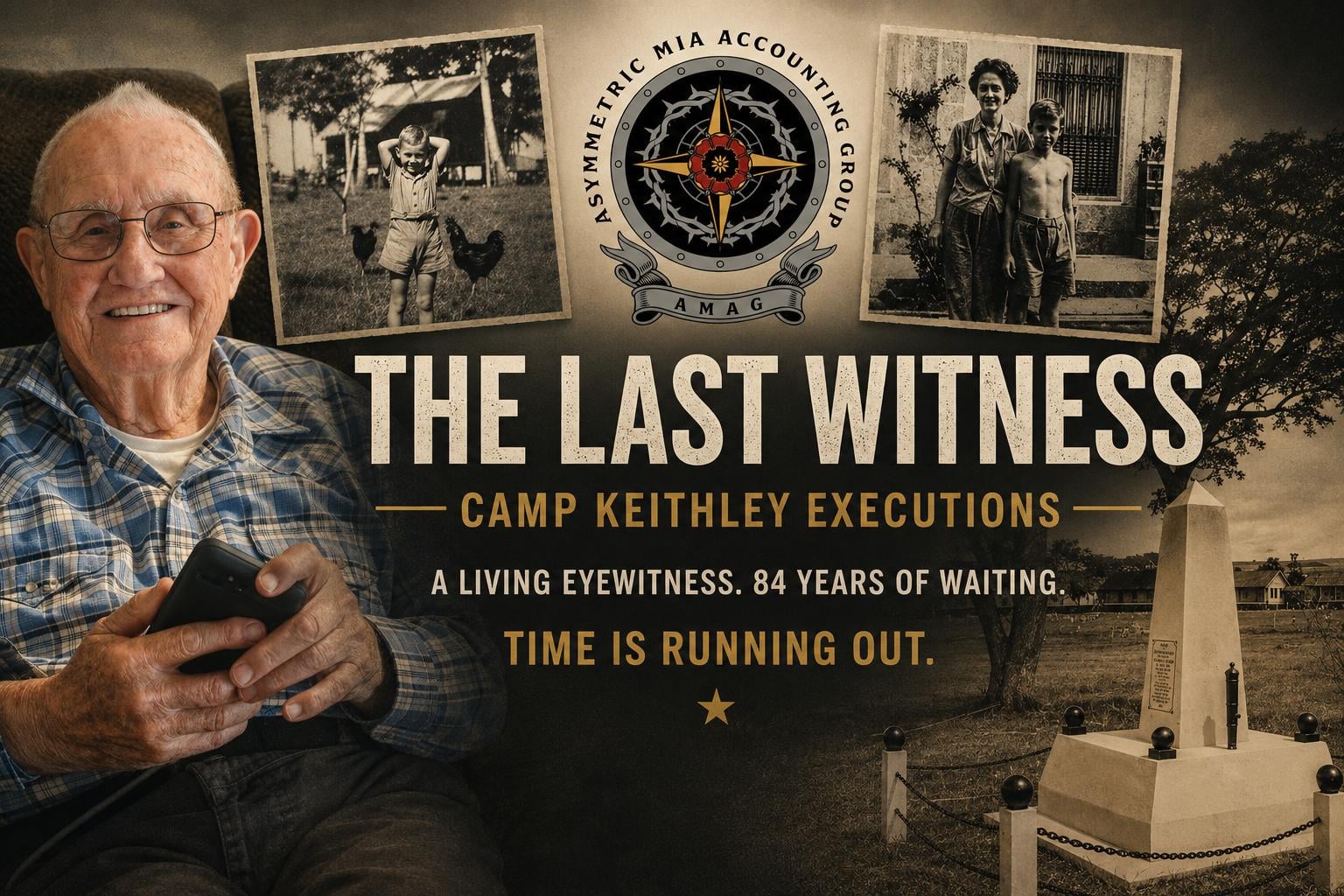
The witness is Benjamin Broadwell Hagans. Now 96 years old, Hagans was only 12 in July 1942 when he was interned by Japanese forces at Camp Keithley. He was forced to watch as Lt. Col. Robert Hale Vesey, Capt. Albert H. Price and 1st Sgt. John L. Chandler were tied to stakes and executed in retaliation for the escape of four American prisoners. Hagans has described the scene in vivid detail, including the approximate location of the killings and where he believes the bodies were buried near the historic Camp Keithley monument.
Such testimony is extraordinarily rare 84 years after the fact. Yet more than a year after AMAG brought Hagans to DPAA’s attention — and despite two major investigative missions to the site in January and April 2026 — the agency has not interviewed him. Not by telephone, video call or in person.
Time is running out. At 96, Hagans is the last living eyewitness to these executions. Every month of delay brings the real risk that this irreplaceable first-hand account — and any chance it offers to locate the missing men — will be lost forever.
A Story of Extraordinary Sacrifice
The Camp Keithley executions were part of a larger tragedy that still resonates in Mindanao. Brig. Gen. Guy O. Fort, a longtime resident of Lanao who spoke local languages and commanded deep respect among the Meranaw and Magindanaw people, had refused Japanese demands to betray the Moro resistance fighters he had helped organize. That refusal ultimately cost him his life in November 1942.
On July 3, 1942, after four American prisoners escaped, Japanese forces selected prisoners for public execution as a deterrent. When Fort was among those chosen, Lt. Col. Vesey — a West Point graduate — stepped forward and volunteered to take his place. “Cut General Fort down,” Vesey commanded. “I’ll take his place.”
Vesey, Price and Chandler were then subjected to a prolonged and brutal execution. Twelve-year-old Benjamin Hagans was forced to witness the entire ordeal. The bodies were reportedly buried nearby. None of the three men has ever been recovered.
Fort survived temporarily, only to be executed later for the same act of defiance.
The first major public account of Hagans’ testimony appeared in a September 2025 War Horse article that detailed his childhood on Mindanao, his internment, and his vivid memories of the executions. A follow-up War Horse article published on February 19, 2026, explored AMAG’s on-the-ground efforts in Mindanao and included direct comments from DPAA officials.
A Year of Outreach, No Interview
AMAG has pursued consistent, transparent engagement with DPAA since the spring of 2025:
- On May 2, 2025, Mike Henshaw met in person at DPAA headquarters in Arlington, Virginia, and announced AMAG’s involvement with the Fort family, stating that further detailed information on the Camp Keithley cases would be forthcoming. Other cases were also discussed.
- On May 11, 2025, AMAG submitted a formal proposal to DPAA’s Indo-Pacific Directorate detailing the eyewitness testimony and requesting diplomatic and forensic support.
- On May 12, 2025, DPAA’s Rob Goeke acknowledged receipt but stated that AMAG was not an official partner and that DPAA could not approve or grant access to its work.
- Between May 11, 2025 and March 2026, several additional emails and meetings occurred in which the Mindanao mission and other AMAG cases were discussed.
- In January 2026 and again in April 2026, AMAG completed two investigative missions to Mindanao, conducting on-the-ground research at the Camp Keithley site.
- On March 19, 2026, Henshaw held another in-person meeting at DPAA headquarters with Jennifer Nasarenko, Heather Harris and Rocky Gillette. The Mindanao mission and Camp Keithley cases were discussed in detail.
- On April 18, 2026, John Bear and Mike Henshaw emailed DPAA historian Dr. Gregory Kupsky requesting a briefing on the findings from AMAG’s two investigative missions to Mindanao. No meeting was scheduled.
- On April 28, 2026, the Philippine National Commission for Culture and the Arts (NCCA) wrote to AMAG reiterating that coordination with DPAA was required for any permit.
- On April 30, 2026, Henshaw emailed DPAA Director Kelly McKeague requesting written clarification on four specific points to facilitate Philippine permitting and asked for a response no later than May 5.
- On May 4, 2026, Henshaw sent a follow-up reminder emphasizing the time-sensitive nature of the mission.
- On May 5, 2026, DPAA responded that the memo was ready but required clearing one more “hurdle” and promised release within two days.
- As of May 10, 2026, DPAA had still not provided the requested memo and had offered no explanation for the additional delay.
A Time-Sensitive Lead Ignored
In most World War II accounting cases, investigators must rely on fragmentary records and second-hand recollections collected decades after the events. Living eyewitnesses are almost nonexistent. Benjamin Hagans, at 96, remains available and willing to assist. His testimony provides specific details about the execution site, the sequence of events and the approximate burial location.
DPAA’s own March 18, 2026 case summary for Brig. Gen. Fort explicitly cites Hagans’ testimony and the February 2026 War Horse article. The agency knows who he is. It knows what he saw. It knows the location. Yet DPAA has never interviewed him.
The physical landscape at Camp Keithley is also changing rapidly due to urbanization in Marawi. The window for responsible documentation and potential recovery is closing. Benjamin Hagans is 96 years old. The families of the missing have waited 84 years.
In the February 19, 2026 War Horse article, DPAA Partnerships Director Rocky Gillette stated that the agency “is not going to hinder anybody” from doing legal work with the host nation, adding, “at the end of the day if they’re successful, a family will potentially get some closure — and that’s a wonderful thing.” DPAA historian Gregory Kupsky also noted that the Camp Keithley monument area “is a great starting point that you wouldn’t get in a lot of other cases.”
Yet DPAA has not interviewed the eyewitness whose testimony could make that starting point actionable.
On April 9, 2026, Brig. Gen. Fort’s personal artifacts — preserved by his step-granddaughter Barbara Fox were returned to Mindanao through AMAG’s Mike Henshaw — presented in a public ceremony of cultural restitution and remembrance.
Questions for DPAA Leadership and Congressional Oversight
DPAA’s statutory mandate is clear: provide the fullest possible accounting of U.S. personnel missing from past conflicts. A living eyewitness to the execution and possible burial of three missing American service members represents exactly the kind of actionable lead the agency exists to act upon.
If DPAA will not promptly interview a 96-year-old eyewitness who has already come forward and offered to assist, what does “fullest possible accounting” mean in practice?
The American people, the families of the missing, and Congress — which created and funds DPAA — have a right to expect urgency when such a rare opportunity presents itself.
DPAA has the ability and the responsibility to act. It can interview Benjamin Hagans immediately. It can provide the written clarification repeatedly requested. It can support responsible coordination with AMAG and the Philippine authorities.
Or it can explain to Congress, to the families and to the American public why the only living witness to these executions was left waiting for more than a year while the agency charged with bringing America’s missing home did nothing.
The families have waited 84 years. Benjamin Hagans has carried this memory since he was 12. Camp Keithley is still there — but not forever.
AMAG remains ready to assist in any appropriate manner. The question now rests with DPAA Director Kelly McKeague and those charged with the agency’s oversight.
Sources
- Defense POW/MIA Accounting Agency, Case Summary: Brig Gen Guy O. Fort, 18 March 2026 (explicitly cites Benjamin Hagans’ testimony and the February 2026 War Horse article).
- “American MIA Group and Filipino Muslim Government Unite to Bring Home World War II Servicemen,” The War Horse, 19 February 2026: https://thewarhorse.org/world-war-ii-soldiers-search-philippines/ (includes direct DPAA comments).
- “WWII POW Execution Remains Search,” The War Horse, September 2025: https://thewarhorse.org/wwii-pow-execution-remains-search/ (first major public account of Hagans’ testimony also covered by the Military Times.)
- AMAG internal records of correspondence and meetings with DPAA (May 2025–May 2026).
- Philippine National Commission for Culture and the Arts (NCCA) correspondence, March–April 2026.
- AMAG investigative mission reports, January and April 2026.
About AMAG
The Asymmetric MIA Accounting Group is a disabled combat veteran-owned 501(c)(3) all-volunteer nonprofit founded in 2025 to assist families of military personnel missing in action from all wars. We operate independently, self-funded, and without any U.S. federal support. We work at the request of families and in genuine partnership with host-nation authorities where official efforts cannot reach.
Investigative Researcher & Host of Stories of Sacrifice Podcast
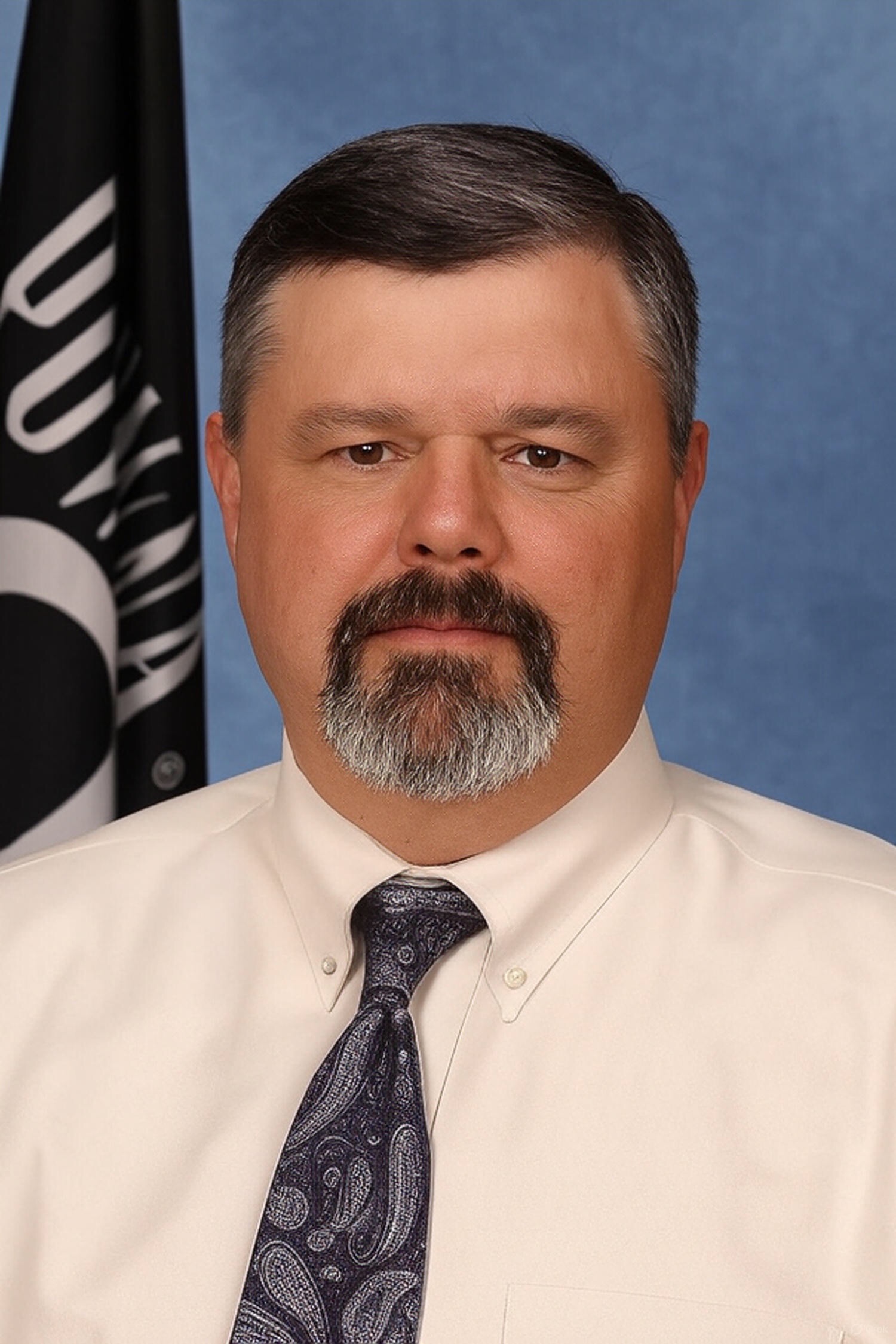
John Bear is an accomplished investigator and forensic genealogist with over 20 years of experience specializing in World War II, Korea, and Vietnam War POW/MIA cases. He has honed forensic-level skills in open-source intelligence (OSINT) and archival research, bolstered by coursework in Advanced Research Methods and Databases for Historians. Inspired by the loss of his uncle, a WWII POW/MIA identified posthumously in the Philippines, John volunteers directly with families of the missing to provide answers and closure. As a key member of the Asymmetric MIA Accounting Group (AMAG), he works directly with MIA families to support projects alongside Military Service Casualty Officers, DPAA Historians, and military intelligence experts. Through his contributions to the Cabanatuan POW Camp, Philippine Hellship Project, and Bataan Death March, John’s efforts have led to over 350 potential WWII identifications through Family Reference Sample (FRS) DNA collection. His investigation into the Vietnam War’s Baron 52 incident uncovered compelling OSINT-based evidence suggesting crew survival, and his work on WWII unrecovered MIAs on Mindanao has generated critical leads. Through his podcast, Stories of Sacrifice: American POW/MIAs, John amplifies families’ stories, ensuring the legacies of the missing are honored.
Baron 52 Docu series Podcast Link: https://www.storiesofsacrifice.org/category/baron-52/
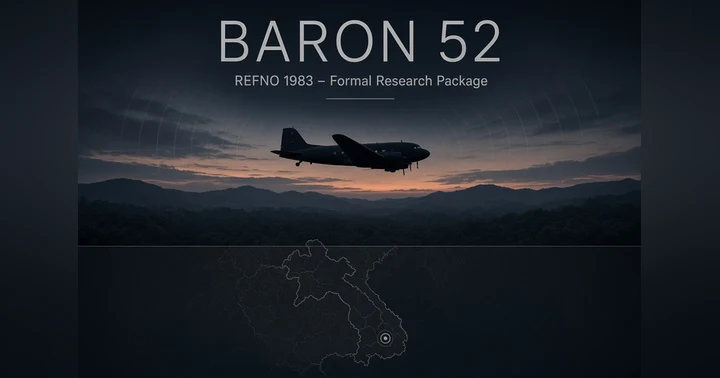
Baron 52: New Vietnamese Sources and the Case for Technical Review


